
1. What a “Chinese mini dumper” actually means
A Chinese mini dumper is simply a small material-carrying dumper made by a manufacturer in China. It’s not one special design. It’s a category that covers lots of models: tracked, wheeled, walk-behind, ride-on, gasoline, diesel, and electric.
In the market, “Chinese” usually signals three things:
- Big variety (many sizes and configurations)
- Competitive pricing
- Quality range is wide (excellent to “looks OK in photos but fails on site”)
So the real question isn’t “Is it Chinese?” but “Is it built and supported like a jobsite machine, or like a one-season toy?”
2. What a mini dumper is (in plain words)
A mini dumper is a compact machine that does one job really well:
It carries heavy material from A to B and dumps it where you want.
Think of it as a powered wheelbarrow—but with:
- much higher payload,
- better traction,
- controlled dumping (not back-breaking manual tipping),
- and a footprint small enough for tight sites.
Depending on the style, it may be walk-behind (operator walks) or ride-on (operator stands/sits).
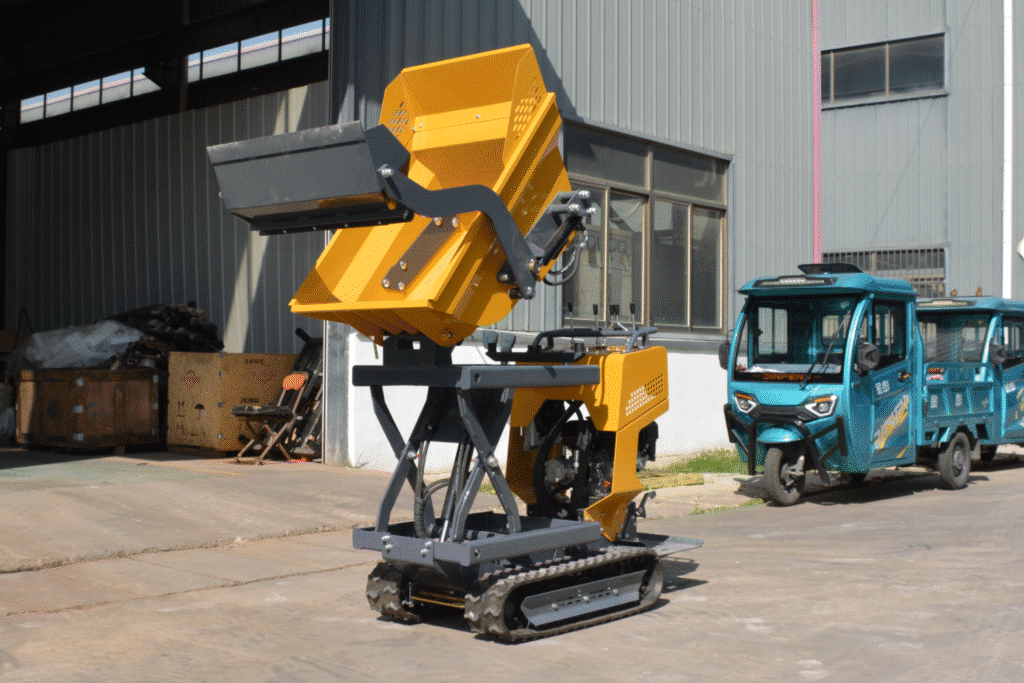
3. The core parts: what’s inside the machine
Even though models vary, most mini dumpers share the same building blocks:
Power source
- Gasoline: common on smaller units, easier cold start, simple service
- Diesel: torque-friendly, often preferred for heavy-duty work
- Electric (battery): low noise, great for indoor/urban work, less daily maintenance
Drive system
- Tracks (rubber tracks) or wheels
- A gearbox/hydraulic drive that turns engine/motor power into movement
The skip (bucket / tray)
This is the “bed” that holds soil, sand, gravel, tools, firewood, manure, etc.
The tipping mechanism
Usually:
- Hydraulic tipping (a cylinder pushes the skip up)
- Or manual tipping on very small/basic machines
Controls & safety items
- Throttle / speed control
- Forward/reverse
- Steering levers or handlebars
- Emergency stop (common on newer compliant designs)
- Parking brake / holding brake (very important on slopes)
4. How it works step-by-step (drive + dump)
Here’s the simple picture. A mini dumper has two “actions”:
- Move the load
- Tip the load
Step A: Power is created
- An engine burns fuel, or a motor draws battery power.
- That power spins a shaft (engine) or motor output.
Step B: Power is turned into pushing force
Depending on the model:
- Mechanical drive uses belts/chains/gearbox to turn wheels or sprockets.
- Hydraulic drive uses a pump and hydraulic motors to drive tracks/wheels smoothly.
Hydraulic drive is popular because it’s:
- smooth at low speed,
- easier to control in tight areas,
- and strong under load.
Step C: Tracks/wheels move the machine
- On tracked dumpers, the tracks spread the weight and grip soft ground better.
- Turning is usually done by slowing one side and speeding the other side.
Step D: The skip tips to dump
In a hydraulic tipping system:
- A pump sends oil to a valve.
- The valve directs oil into a tipping cylinder.
- The cylinder extends, lifting the skip.
- Release the control, and it returns down (by gravity or controlled hydraulics).
That’s the whole story: power → movement → controlled dump.
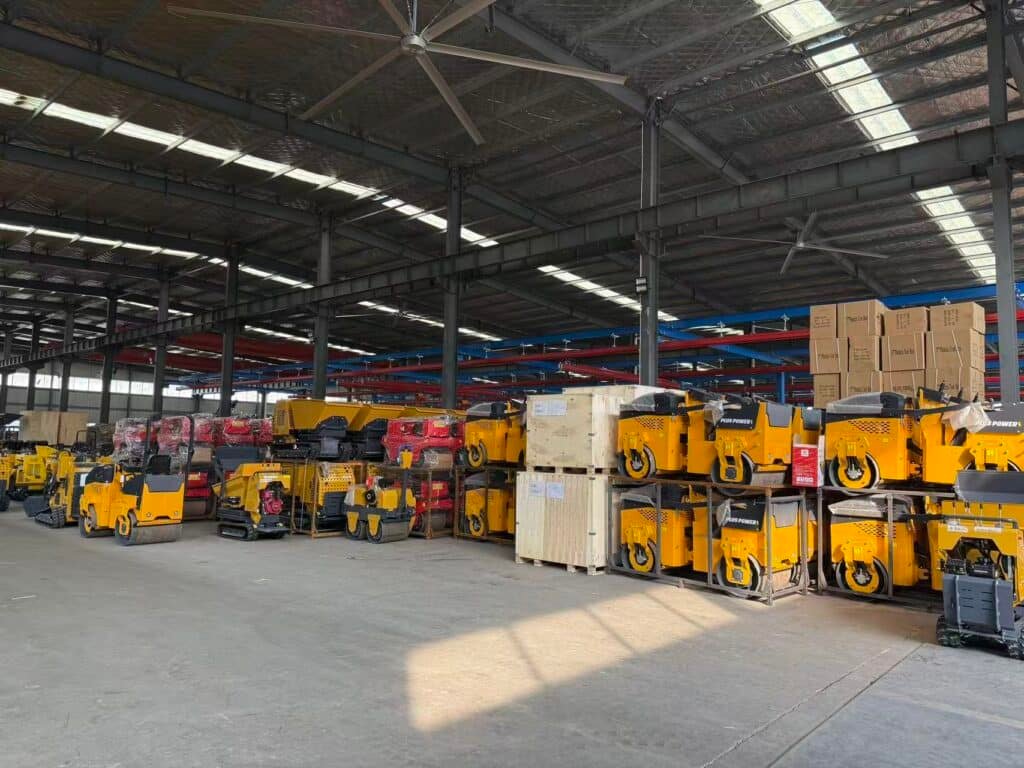
5. Main types of Chinese mini dumpers
This is where buyers often get confused, because photos look similar. The type matters more than the paint color.
H2: Tracked mini dumper
Best for: mud, sand, grass, slopes, uneven ground
Why it’s popular: tracks give better traction and lower ground pressure
Common buyer mistake: choosing tracks without checking track width + roller quality + track tension design. Cheap undercarriage parts wear fast and start derailing.
H2: Wheeled mini dumper
Best for: hard ground, concrete, warehouse floors, paved paths
Pros: faster travel, often cheaper, simpler rolling resistance
Cons: can get stuck easier in mud and soft soil
H2: High-tip mini dumper
Best for: dumping into a truck, skip, container, or over a wall
The skip lifts upward and tips, so material can discharge higher.
Key check: stability when raised (center of gravity shifts). A well-designed frame and good track width matter.
H2: Swivel / rotating skip dumper
Best for: tight landscaping sites
The skip rotates left/right so dumping doesn’t require turning the whole machine.
Key check: the rotation mechanism quality (pins, bearings, and lock design).
H2: Ride-on vs walk-behind
- Walk-behind: cheaper, compact, great for narrow access
- Ride-on: faster job cycles, less operator fatigue, better for rental fleets and daily production
6. What people use mini dumpers for (real scenarios)
Mini dumpers show up anywhere there’s heavy material and limited access:
- Landscaping: moving soil, mulch, pavers, gravel
- Farms: feed, manure, fencing supplies, harvested produce
- Construction & renovation: demolition waste, sand/cement bags, backfill
- Rental fleets: “easy to rent, easy to learn, hard to destroy” (if built right)
- Municipal work: parks, sidewalks, small maintenance tasks
A good mini dumper shines in jobs where a skid steer is too big, and wheelbarrows are too slow.
7. Why many buyers choose Chinese mini dumpers (and where problems happen)
Why buyers like them
- Strong value for money
- Tons of configurations (tracks, high-tip, electric, etc.)
- Shorter lead times when the factory is organized
Where problems happen (the honest list)
- Hydraulic leaks after a few months (cheap hoses, poor routing, weak clamps)
- Undercarriage wear (rollers, idlers, sprockets) on tracked models
- Weak weld areas on the skip hinge and frame corners
- Electrics that hate rain (connectors and harness protection not jobsite-grade)
- Documents and compliance gaps (bad labeling, missing declarations, unclear manuals)
That last one matters a lot for importers/distributors in regulated markets.
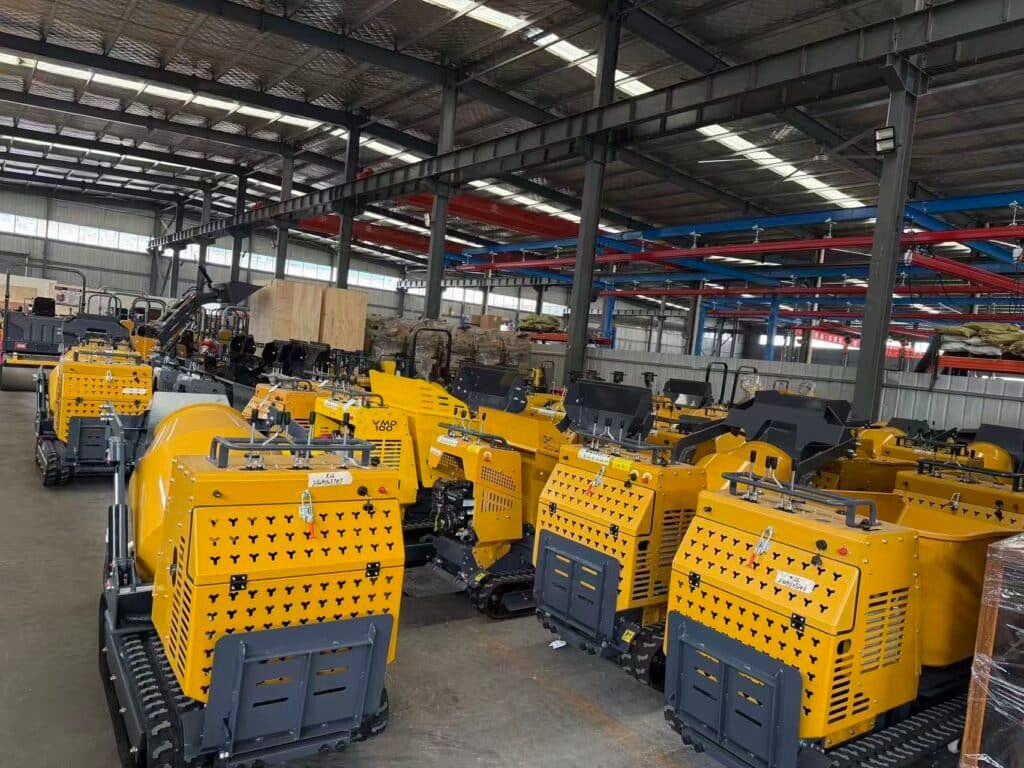
8. What to check before buying (quality + documents + specs that matter)
This section saves the most money—because fixing a bad dumper after it lands is painful.
H2: Match the machine to the job (don’t start with price)
Ask these first:
- What material? soil, gravel, rubble, manure, firewood?
- How far per trip?
- How narrow is the access? gates, doors, garden paths?
- Any slopes? how steep?
- Dump into a pile on the ground, or into a truck/container?
From those answers, the right type becomes obvious (tracked vs wheeled, high-tip or not, payload class).
H2: Payload and skip size (marketing numbers can mislead)
Two dumpers can both claim “500 kg” but behave very differently:
- One has a strong frame and stable tracks.
- Another tips forward on slopes and cracks near the hinge.
A practical check: ask for a loaded stability video on an incline and during tipping. A serious supplier can provide it.
H2: Hydraulics (simple checks non-engineers can do)
Even without technical expertise, these checks work:
- Are hoses protected from rubbing and sharp edges?
- Are fittings tidy and consistent, or random mixed parts?
- Is the valve area clean and accessible for service?
- Is there a proper return filtration setup (or at least sensible oil cleanliness practices)?
Hydraulic leaks are not “normal.” They are usually design choices.
H2: Undercarriage on tracked models
Look for:
- track tension that can be adjusted easily,
- rollers that look sealed and robust,
- and a frame that doesn’t twist.
Tracks are where cheap machines reveal themselves fastest.
H2: Controls and safety features
Better machines usually include:
- dead-man / presence control (especially walk-behind),
- emergency stop,
- parking brake or strong holding brake.
Even if local law doesn’t force it, rental customers and jobsite rules often do.
H2: Compliance and marking (EU/UK buyers should pay attention)
For Europe, machinery compliance is evolving. The EU Machinery Regulation (EU) 2023/1230 replaces the old Machinery Directive and becomes applicable from 20 January 2027.
For Great Britain, official UK guidance indicates the UK intends to continue recognizing CE marking across Great Britain beyond December 2024 (policy intent described in the guidance).
Practical takeaway for importers: ask the supplier for a clean document pack (declaration, manual, labeling), and make sure the machine’s labeling matches the paperwork.
(This is general information, not legal advice.)
H2: After-sales: parts and communication (this is where profits are made or lost)
Importers and rental fleets should confirm:
- what spare parts are stocked,
- typical shipping time for parts,
- and whether the supplier can provide exploded diagrams and part numbers.
A cheap machine with slow parts support becomes an expensive machine fast.
9. Safety basics operators often ignore
Mini dumpers look small, so people treat them casually. That’s how accidents happen.
H2: The three big risks
- Tip-over on slopes (especially when turning or dumping)
- Runaway machine (poor brakes, poor control habits)
- Crush and pinch points (skip linkage, undercarriage, loading zones)
Ireland’s safety guidance for site dumpers highlights key operational controls and management practices for dumpers on construction sites.
H2: Simple rules that prevent most incidents
- Keep the load low when traveling.
- Go straight up/down slopes when possible; avoid turning across slopes.
- Don’t overload just because “it fits.”
- Use a spotter in tight areas and around reversing routes.
- Park with the brake on, and don’t leave it idling on a slope.
For US buyers: OSHA’s powered industrial truck rule is aimed at forklifts and similar trucks, and it specifically notes it does not apply to vehicles intended primarily for earth moving. That doesn’t mean “no rules”—it means jobsite safety still matters, and local/site policies apply.
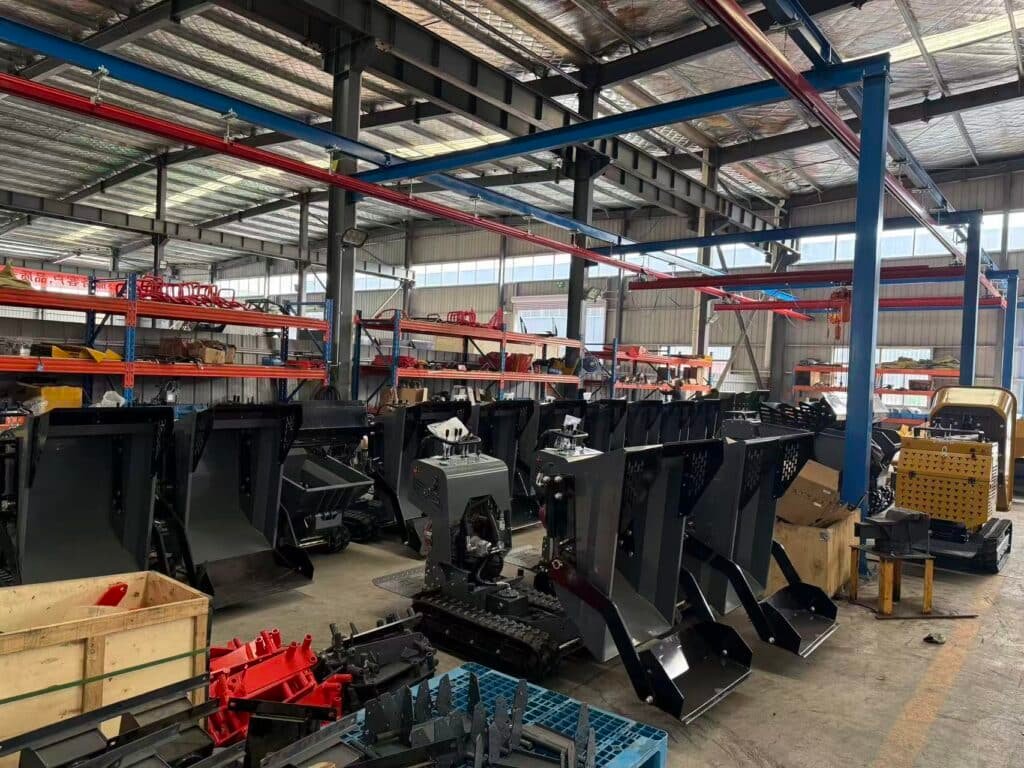
10. Where Nicosail fits in
When buyers look at Chinese mini dumpers, the real challenge is not finding a supplier—it’s finding repeatable quality and clean export documentation, plus a machine designed like a tool, not a toy.
That’s the reason brands like Nicosail tend to work well for importers, rental businesses, and contractors who care about fewer headaches:
- models are typically offered with practical configurations (like tracked options and jobsite-focused features),
- customization is available without turning every order into a “prototype,”
- and the overall approach is closer to “export-ready machine + support,” not “ship and disappear.”
In short: Nicosail is worth considering when the goal is stable quality and long-term cooperation, not just a one-time cheap buy.
FAQ
1) Is a Chinese mini dumper good quality?
It can be very good. China has factories that build excellent machines and factories that cut corners. The safest way to judge is by undercarriage build, hydraulic layout, weld quality, and documentation discipline, not by photos.
2) Tracked or wheeled: which one should be chosen?
- Choose tracked for mud, grass, slopes, uneven ground.
- Choose wheeled for hard flat surfaces and faster travel on paved areas.
3) What’s the biggest mistake first-time buyers make?
Buying by payload number alone. Real-world performance is about stability, traction, and durability, not just “kg in the brochure.”
4) Do mini dumpers need CE marking in Europe?
Market access depends on classification and destination rules, but machinery sold into the EU typically needs appropriate compliance and documentation. The EU framework (including the new Machinery Regulation (EU) 2023/1230) becomes applicable from 20 January 2027.
Always verify with a compliance professional for the specific product and market.
5) Can a mini dumper dump into a truck?
Yes—if it’s a high-tip model and the dump height matches the truck side height. Always check stability when raised.
6) Are electric mini dumpers worth it?
They’re great for low-noise areas, indoor work, and places where fuel storage is inconvenient. The key is battery quality, weatherproofing, and parts support.
7) What should an importer ask a supplier before ordering?
- Spare parts list + lead time
- Documentation pack sample (manual, declaration, labels)
- Real videos: loaded driving, turning, dumping, slope test
- Warranty terms and response time
Quick summary
A Chinese mini dumper is a compact material carrier made in China—often tracked or wheeled—built to move heavy loads through tight spaces and dump them safely. It works by turning engine or motor power into drive (tracks/wheels) and into tipping force (usually hydraulic). The “right” dumper depends on terrain, access width, slope, and dump height needs. The smartest buying approach focuses on undercarriage durability, hydraulic cleanliness, frame/weld strength, safety features, and export documentation. For buyers who want fewer surprises, brands like Nicosail are typically a safer short-list option because they tend to emphasize export readiness and consistent build quality rather than only low price.