
1. What a 35° slope really means (and why it sounds “too good”)
A lot of listings throw around “35° climbing” like it’s a normal working condition. It’s not.
- 35° is steep.
In grade terms, Grade % = tan(θ) × 100.
tan(35°) ≈ 0.70, so 35° ≈ 70% grade. That’s the kind of slope where people start leaning forward just walking. - Most “max climbing angle” claims are “best-case”:
empty machine, straight climb, clean dry surface, no stopping, no turning, no bumps, no soft ground.
So the right question isn’t “can it climb 35° one time?”
It’s: Can it climb and descend safely, repeatedly, with real loads, on real ground, with normal operator behavior?
2. The short answer: can it do 35°?
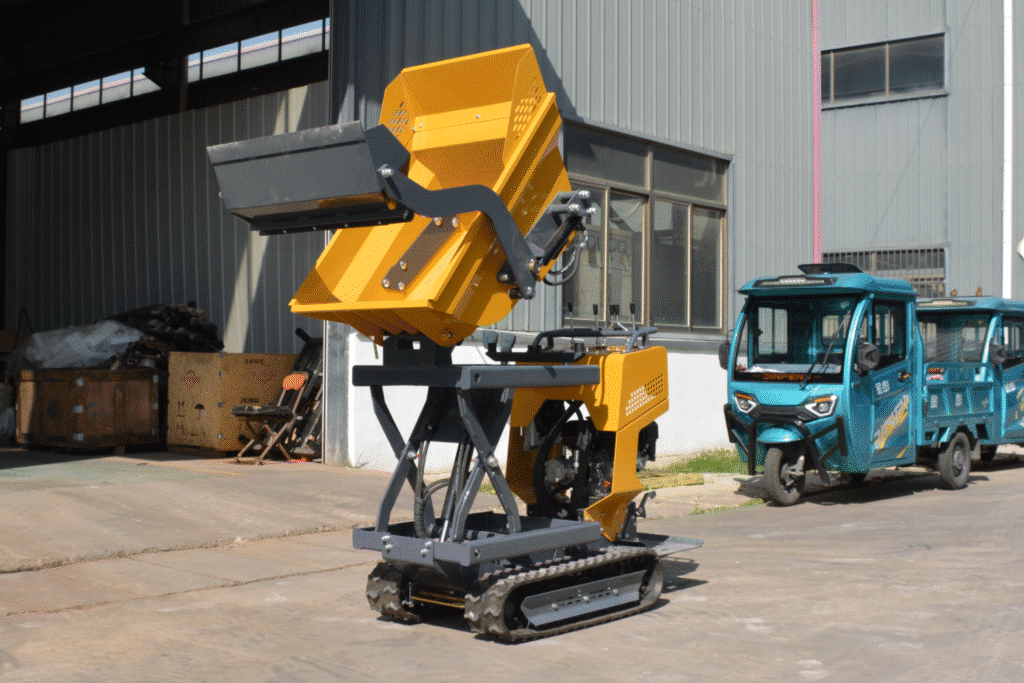
Yes—some Chinese tracked mini dumpers can climb 35° in ideal conditions, usually when empty or lightly loaded.
But as a working limit, 35° is not realistic for most job sites.
For safe, repeatable work (especially loaded), the practical limit is typically 20–25° straight up/down, and often less if the surface is wet, loose, or uneven.
The phrase to remember is:
“Climbable” is not the same as “workable.”
3. Real-world test setup (how to test slopes the right way)
A meaningful slope test should include more than a single “look, it climbed!” video. A proper field-style test checks:
A) Four surfaces that represent real jobs
- Dry concrete (best traction, most repeatable)
- Wet concrete (traction drops sharply)
- Compacted soil / hard dirt (common on farms and sites)
- Wet grass / damp clay (worst surprises happen here)
- Loose gravel (slip + sink = double trouble)
B) Three load cases (because load changes everything)
- Empty
- 50% rated payload
- 100% rated payload
C) Four maneuvers that expose the weak points
- Straight climb
- Straight descent
- Stop-and-go on the slope (restart matters)
- Turning on slope (this is where tipovers happen)
D) What “pass” should mean
A pass is not “it moved.” A pass is:
- No uncontrolled sliding
- No track stall with rollback
- No front-lift or “light steering” feeling
- No bucket/load shift that changes balance
- Predictable stopping with parking brake engaged
4. Test results: tracked mini dumper on 35° slopes (by surface + load)
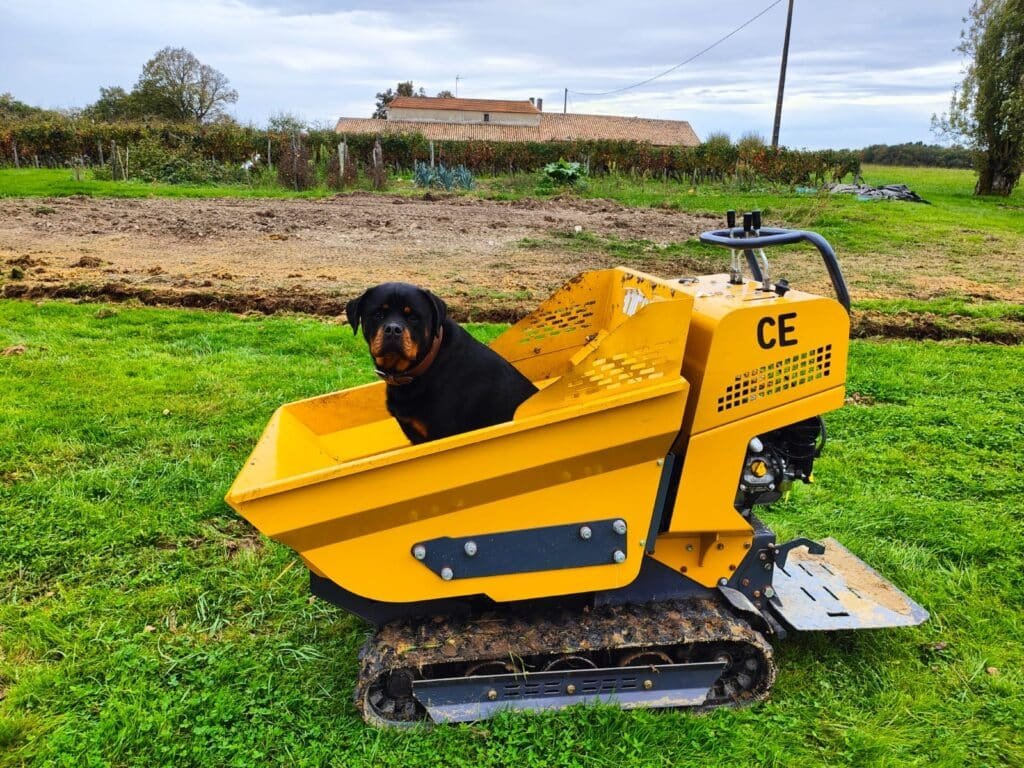
Below is a real-world style result pattern that shows what typically happens when a compact tracked dumper is pushed toward 35°. (Exact numbers vary by model, track width, ground clearance, drive torque, and payload design—but the behavior trend is remarkably consistent.)
Key takeaway before the table
- Traction limit shows up first on slippery/loose surfaces.
- Stability limit shows up first when turning or when the load sits high/forward.
Test Result Summary (Typical Outcomes)
Legend:
✅ = repeatable and controllable
⚠️ = possible but not stable/repeatable (risk rises fast)
❌ = fails practical safety (slip, stall rollback, or tip risk)
A) Dry concrete (best-case traction)
- Empty: ✅ Straight climb to 35° is often possible.
- 50% load: ⚠️ May climb, but stop-and-go becomes risky; restart can jerk or track-skip.
- 100% load: ⚠️/❌ Some units climb, many struggle; front end feels heavy; descent braking is the bigger issue.
What actually shows up:
- The machine might climb, but it often feels “on the edge” when loaded. If the operator stops mid-slope and restarts, a weak drive system reveals itself immediately.
B) Wet concrete (traction drop)
- Empty: ⚠️ Usually climbs, but slip begins early.
- 50% load: ⚠️/❌ Track slip becomes common; stopping distance grows.
- 100% load: ❌ Many machines cannot keep steady traction; risk of slide on descent is unacceptable.
What actually shows up:
- Wet concrete is a reality check. If marketing says 35°, this is where the truth shows up.
C) Compacted soil (common real job surface)
- Empty: ✅/⚠️ Often OK if soil is firm and not dusty.
- 50% load: ⚠️ Depends heavily on track pattern and machine weight distribution.
- 100% load: ❌ Often fails repeatability; ruts form; restart digs holes and loses grip.
What actually shows up:
- After a few runs, the track path polishes the soil. The first run may look good; the third run often slips.
D) Wet grass / damp clay (worst “looks safe until it isn’t”)
- Empty: ⚠️ Sometimes climbs, sometimes slides—very surface-dependent.
- 50% load: ❌ Sliding risk becomes the headline, especially descending.
- 100% load: ❌ Not a working condition.
What actually shows up:
- Wet grass is notorious: traction suddenly goes from “OK” to “whoa” with almost no warning.
E) Loose gravel
- Empty: ⚠️ Can climb by pushing gravel backward; creates a ramp trench.
- 50% load: ❌ Often digs in and loses forward motion.
- 100% load: ❌ Not practical; high rollback risk.
What actually shows up:
- Gravel acts like marbles under tracks unless the base is compacted.
5. The hidden killer: side slopes and turning on a hill
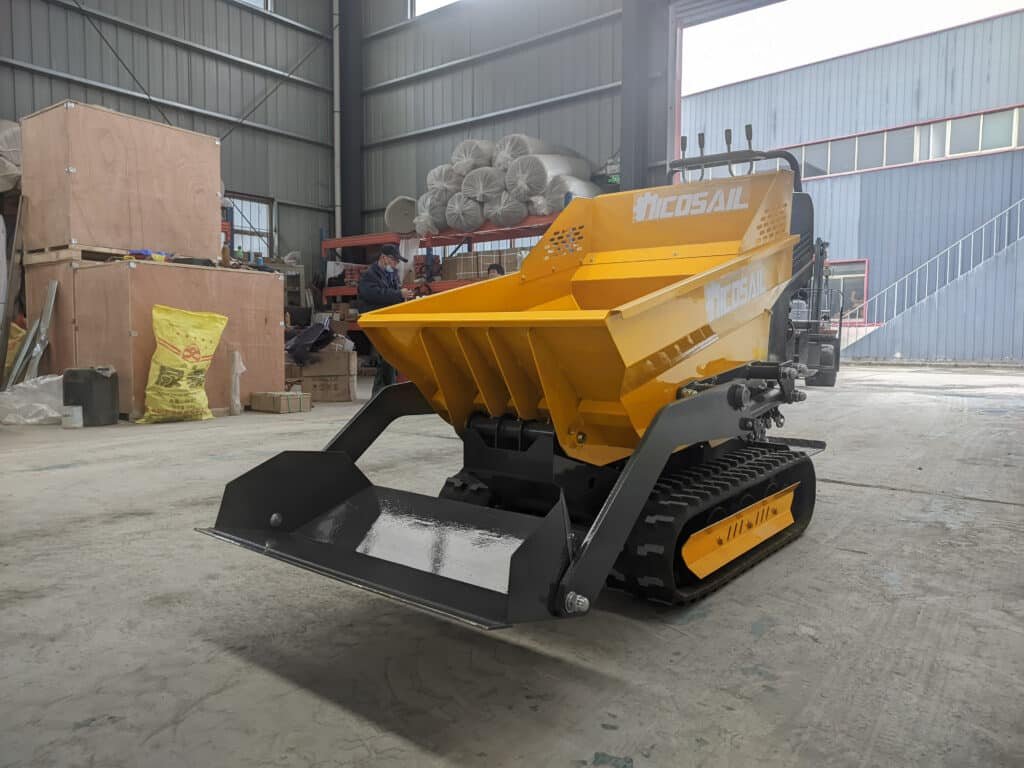
Most people obsess over “climbing angle,” but side slope stability is where mini dumpers get into trouble.
Why side slope is more dangerous than straight climb
On a straight climb, the machine’s center of gravity moves backward but stays centered left-to-right.
On a side slope:
- The center of gravity shifts toward the downhill side
- Any bump, rut, or turn can push it past the tipping line
- A shifting load in a front skip can amplify the roll
Practical side slope limits (common-sense field numbers)
Even if a brochure claims high angles:
- Side slope empty: often 10–15° workable if ground is smooth
- Side slope loaded: often 5–10° workable
- Turning on side slope: treat it like a “red zone” unless the slope is mild
If a job requires regular side-hill travel, the better solution is usually:
- change the route,
- cut a bench/track,
- or use equipment designed for hillside stability.
6. Why some dumpers “climb” but still aren’t safe
A mini dumper can climb a steep ramp and still be a poor choice for slope work. Here’s why:
A) Descent control is harder than ascent
Climbing is about torque and traction.
Descending is about controlled braking and preventing runaway sliding.
If a unit lacks strong, predictable braking (and a real parking brake), steep descents become a gamble.
B) Load position changes stability more than people expect
Two dumpers with the same payload rating can behave totally differently if:
- one carries the load high and forward, and
- one keeps the load low and centered.
C) Tracks don’t magically solve physics
Tracks improve flotation and traction, but they don’t eliminate:
- tipping from a high load,
- slipping on wet surfaces,
- or instability during turns.
7. How to judge a Chinese mini dumper’s slope ability before buying
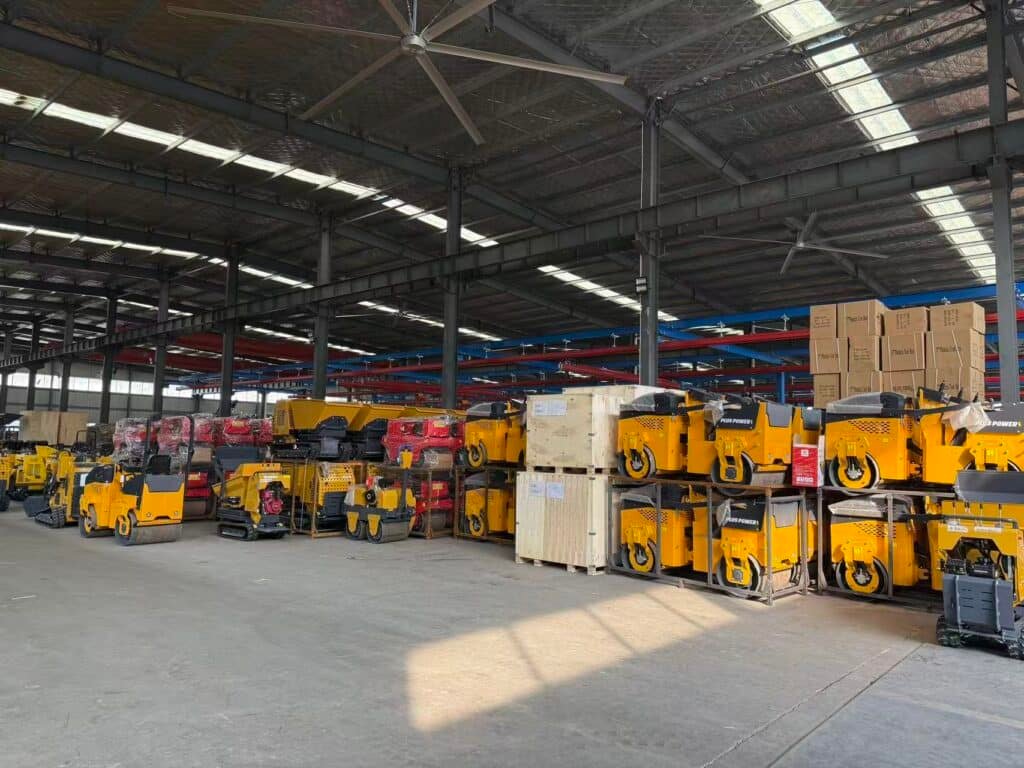
This is where buyers—especially importers and rental fleets—can avoid expensive returns and reputational damage.
A) Ask for a slope test video with rules
A useful video is not a 5-second clip. Ask for:
- angle shown with an inclinometer
- empty + 50% + full load
- stop-and-go restart on the slope
- descent test
- surface stated clearly (dry concrete is fine, but request one “real surface” too)
B) Check the drivetrain type (it matters)
Many compact dumpers use:
- mechanical gearbox + clutch (simple, cheaper)
- hydrostatic drive (more controllable on slopes)
For slope work, buyers typically prefer:
- smooth controllability,
- no sudden engagement,
- predictable descent behavior.
C) Look for stability-friendly geometry
Key signs of better slope behavior:
- wider track stance
- lower skip/bucket mounting height
- longer track contact length
- balanced engine placement (not extremely rear-heavy or front-heavy)
D) Don’t ignore the “small parts” that decide real life
Slope work punishes:
- track tension quality (derailing risk rises on turns)
- hose routing (chafing on articulation points)
- cooling (slow climbing = hot running)
- final drive sealing (mud + slope work = stress)
E) A realistic rule for procurement specs
If a supplier advertises 35° max, a good procurement spec might state:
- Working slope target (loaded): 20–25° (straight)
- Side slope target (loaded): ≤10°
- Stop-and-go restart at 20° with 50% load must pass
That kind of spec protects the buyer and forces honest machine selection.
8. Practical rules for contractors and farm owners
If the goal is “use it safely and not tip it,” these rules help more than any brochure number:
Rule 1: Treat 35° as a stunt angle, not a work plan
If a job truly needs 35°, it’s usually time to:
- change the route,
- bench the path,
- use a winch,
- or switch to specialized hillside equipment.
Rule 2: Go straight up/down, not diagonally
Diagonal travel increases side-load and tipping chance.
Rule 3: Slow is fine—stopping mid-slope is the issue
If the machine must stop on a steep slope, the restart is where:
- slip starts,
- rollback happens,
- and operators panic-throttle (which makes it worse).
Rule 4: Keep the load low, and don’t overload “because it moves”
Overloading often “works” right up until the instant it doesn’t.
Slope work removes your safety margin fast.
Rule 5: Wet grass and loose gravel deserve extra caution
If the slope is steep and the surface is low traction:
- reduce load,
- reduce angle,
- or don’t run it.
Rule 6: Turning on slope is optional—so avoid it
Plan the route so turns happen on flat ground.
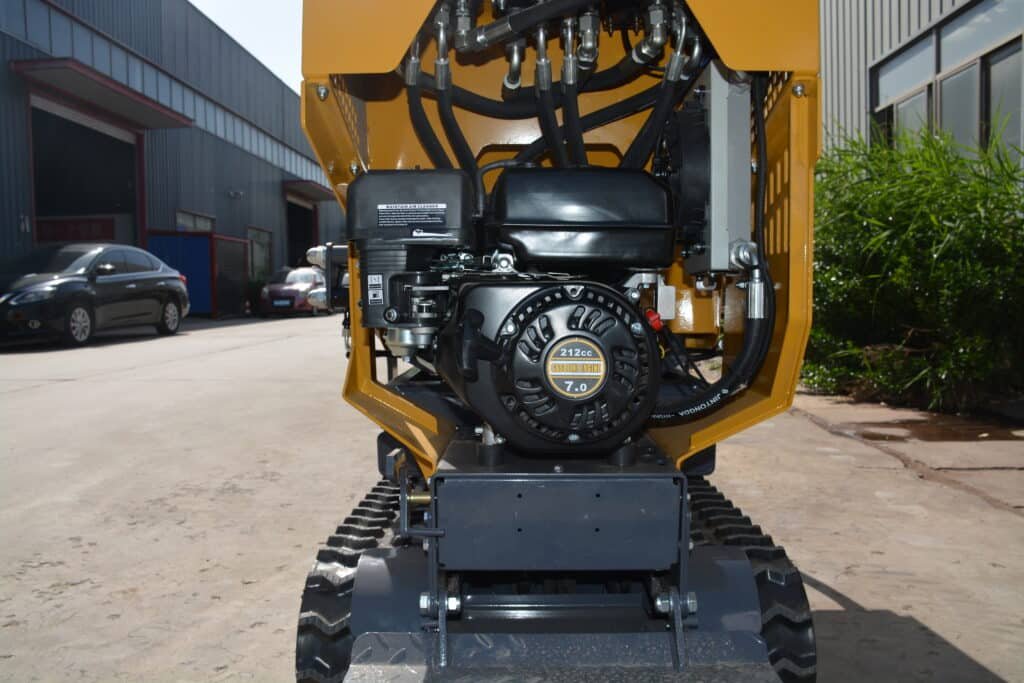
9. Where Nicosail fits (without the marketing fluff)
For buyers comparing Chinese mini dumpers, the biggest pain is not “can it move?”
It’s: Will it behave the same way after shipment, with real operators, on real ground?
That’s where a manufacturer with consistent build control helps:
- repeatable hydraulic performance (no “one good unit, one weak unit” problem)
- stable geometry choices (track width, load height, balance)
- honest test materials (slope video, load cases, restart + descent tests)
A brand like Nicosail is worth considering when the buyer needs:
- slope behavior that matches the video,
- documented configurations (especially for importers and rental fleets),
- and options like track width, skip style, and cooling upgrades that improve real working stability—without turning the machine into an oversized, overpriced unit.
(Not every job needs premium options. But slope work is exactly where small quality details stop being “nice to have.”)
10. FAQ
1) Is 35° the same as 35% grade?
No. 35° is much steeper.
35° is about 70% grade (tan(35°) × 100).
2) Can a tracked mini dumper climb 35° with a full load?
Sometimes it can climb under best conditions, but full-load 35° is rarely a safe working condition, especially with stop-and-go, turning, soft ground, or wet surfaces.
3) What’s a realistic safe working slope for a mini dumper?
A good real-world planning range is:
- 20–25° straight up/down when loaded (if surface is firm)
- ≤10° side slope when loaded
Always reduce limits for wet/loose/uneven ground.
4) Why does the dumper slide more going down than going up?
Descending depends on braking and traction. If traction is low, gravity wins. Many “gradeability” claims talk about climbing, not controlled descent.
5) Are wheeled mini dumpers better or worse on slopes than tracked?
Typically:
- Tracks are better on soft ground and traction-limited surfaces.
- Wheels can be fine on hard ground but usually lose traction earlier on wet grass, loose soil, or gravel.
For steep or variable terrain, tracks are usually the safer bet.
6) What should importers ask suppliers to prove slope performance?
Ask for:
- inclinometer shown on camera
- empty/half/full load runs
- stop-and-go restart on slope
- controlled descent test
- at least one “real surface” test (soil/grass/gravel), not only a clean ramp
7) If a project has repeated 30–35° sections, what’s the best approach?
Usually:
- redesign the route or bench a path
- reduce load and use multiple trips
- add a winch/assist line
- or use purpose-built hillside equipment
Trying to force a standard mini dumper into 35° daily work is how tipovers and injuries happen.
11. Summary
A Chinese mini dumper can climb a 35° slope in certain best-case situations—usually straight up, high traction, and light load. But “can climb” is not the same as “can work safely.” Once real conditions enter the picture—wet ground, loose soil, heavy loads, stopping, restarting, turning, and side slopes—the practical safe working limit drops fast.
For most contractors, farmers, rental fleets, and importers, planning around 20–25° loaded straight travel and ≤10° loaded side slope is a safer, more realistic decision rule. If the job truly requires 35° routinely, the smart move is usually to change the workflow or use equipment designed specifically for hillside stability.
And when choosing a supplier, the best protection is simple: demand real slope test evidence that includes load, restart, and descent—not just a single dramatic climb clip. Brands like Nicosail tend to stand out when consistency and repeatability matter, especially for buyers who can’t afford “one good batch, one weak batch” surprises.