On many small construction sites, farms, gardens, landscaping jobs, and renovation projects, the biggest time loss is not always digging or building. Very often, it is moving material.
Soil, gravel, bricks, concrete waste, firewood, animal feed, sand, mulch, stones, cement bags, and demolition debris all need to move from one place to another. For small teams, this work is slow, tiring, and expensive when done by hand.
That is why many buyers compare three common choices:
A wheelbarrow
A Chinese mini dumper
A skid steer loader
At first, the wheelbarrow looks cheapest. The skid steer looks strongest. The mini dumper sits between them. But payback is not decided only by purchase price. It depends on labor saving, job frequency, transport cost, ground condition, operator skill, maintenance, and how many hours the equipment works each month.
A Chinese mini dumper can pay back faster than many buyers expect, especially when the job involves repeated short-distance material transport in narrow areas. But it is not always the right answer. A wheelbarrow can still be enough for light occasional work. A skid steer can be better when loading, grading, lifting, and attachment work are also needed.
This article explains the practical differences in simple words, like an experienced factory engineer speaking with a buyer before purchase. The goal is not to push the biggest machine. The goal is to help buyers choose the equipment that returns money faster and reduces daily work risk.
Nicosail supplies compact machinery from China for buyers who need practical machines for construction, farming, landscaping, and property work. For a mini dumper, the real value is not only the machine price. It is whether the machine matches the job, arrives safely, has suitable parts support, and can keep working without constant trouble.
What “Pays Back Faster” Really Means
Payback means how quickly the equipment earns back its cost through saved labor, faster work, lower fatigue, more completed jobs, or reduced rental cost.
Many buyers only compare buying price:
Wheelbarrow: low purchase cost
Mini dumper: medium purchase cost
Skid steer: high purchase cost
But this is only the surface.
A cheap tool can become expensive if it needs too much labor. A powerful machine can also become expensive if it sits unused, costs more to transport, or needs skilled operation. Fast payback comes from matching the tool to the real work.
Payback Comes from Several Areas
A machine may pay back through:
Reducing worker hours
Finishing jobs faster
Allowing fewer workers on site
Reducing physical strain
Handling heavier loads safely
Working on mud, slopes, or rough ground
Reducing material spillage
Improving daily productivity
Helping a contractor accept more jobs
For small businesses, labor saving is often the biggest point. If two workers spend many hours moving material by wheelbarrow, a mini dumper may reduce that time strongly. Over many jobs, this saving becomes real money.
Payback Also Depends on Usage Frequency
A machine used once a month pays back slowly. A machine used several days per week can pay back much faster.
Before buying, the buyer should ask:
How often is material moved?
How far is it moved?
How heavy is each load?
How many workers are used now?
Is the work seasonal or year-round?
Can the machine be used on more than one type of job?
A Chinese mini dumper often makes sense when material handling is repeated, physical, and time-consuming, but the site is too small or too soft for a larger loader.
Wheelbarrow: Lowest Cost, Highest Labor Demand
The wheelbarrow is simple, cheap, and easy to understand. It needs no engine, no battery, no hydraulic oil, and almost no training. For very small jobs, it is still useful.
A wheelbarrow is good for garden work, small repairs, short-distance transport, and jobs where the load is light. It can pass through narrow gates and can be stored easily.
But the wheelbarrow has a clear limit: it depends fully on human strength.
Advantages of a Wheelbarrow
The main advantage is low cost. A buyer can purchase several wheelbarrows for much less than one machine. There is almost no maintenance cost. If one breaks, replacement is simple.
It also works where engines are not welcome, such as very quiet areas, indoor spaces, or small gardens with delicate surfaces.
Disadvantages of a Wheelbarrow
The problem is labor.
A worker pushing a heavy wheelbarrow over mud, gravel, slopes, or uneven ground becomes tired quickly. When workers are tired, speed drops and safety risk increases. Loads become smaller. More trips are needed.
A wheelbarrow also has limited capacity. Wet soil, concrete waste, stone, and gravel are heavy. Overloading a wheelbarrow can cause tipping, back strain, wrist strain, and accidents.
For contractors, the real cost of wheelbarrows is not the tool itself. It is the labor time behind every trip.
When a Wheelbarrow Pays Back Fastest
A wheelbarrow pays back fastest when the job is small, occasional, and light.
For example:
Small garden repair
Short material movement
One-time home improvement
Light soil or mulch work
Jobs where a machine cannot enter
Very limited budget
For regular construction or landscaping work, the low price can hide high labor cost.
Chinese Mini Dumper: Small Machine, Big Labor Saving
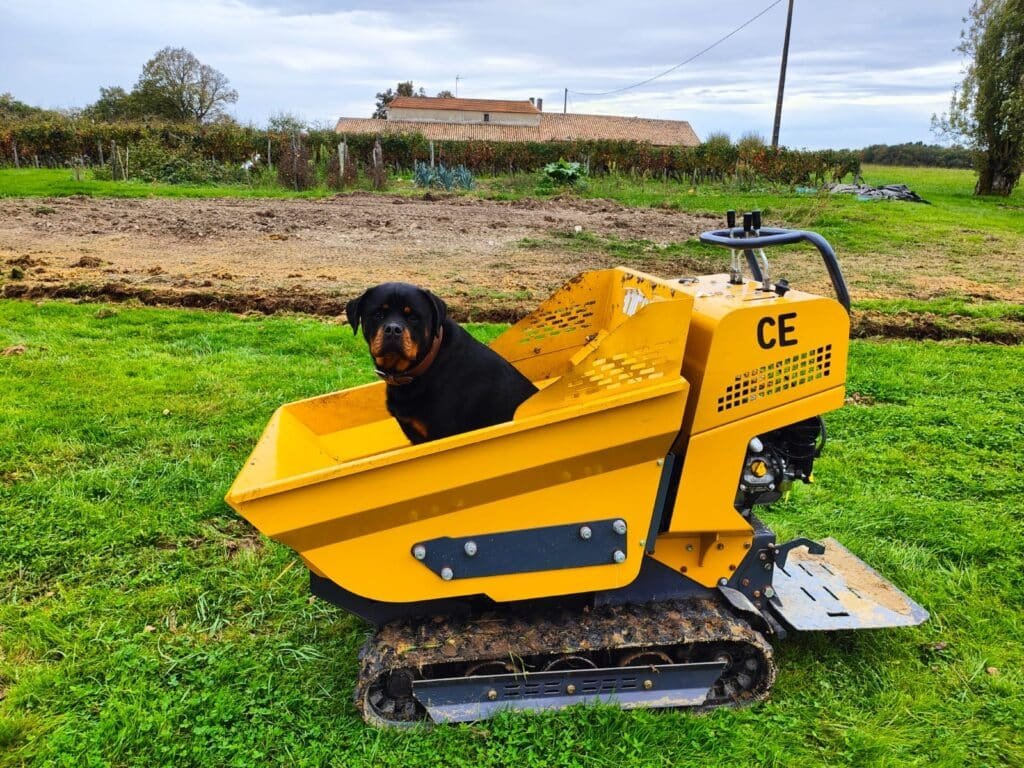
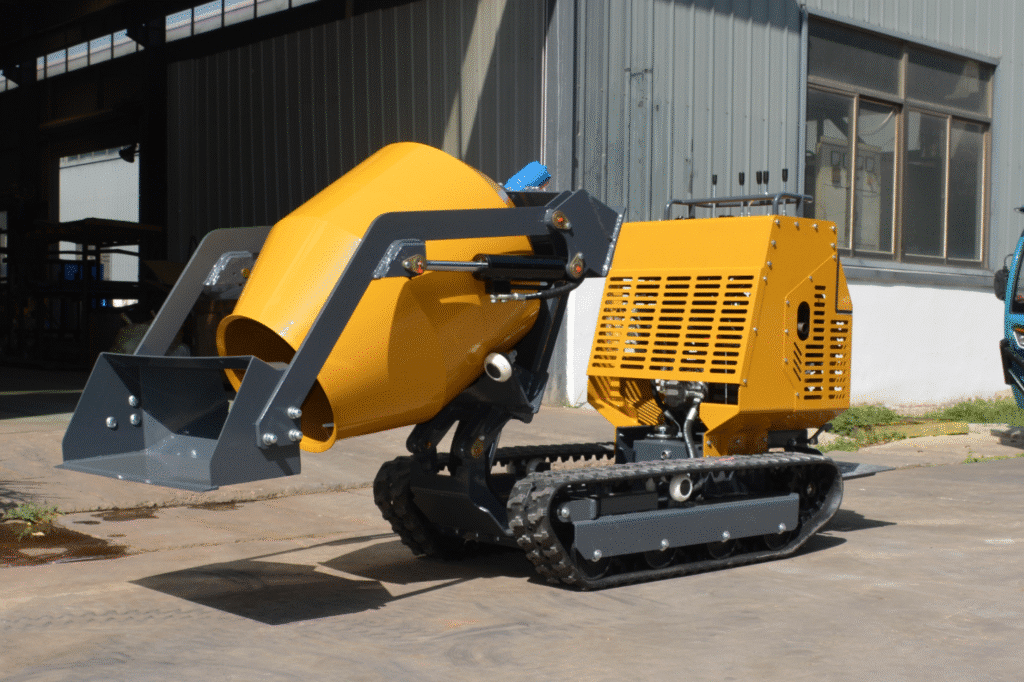
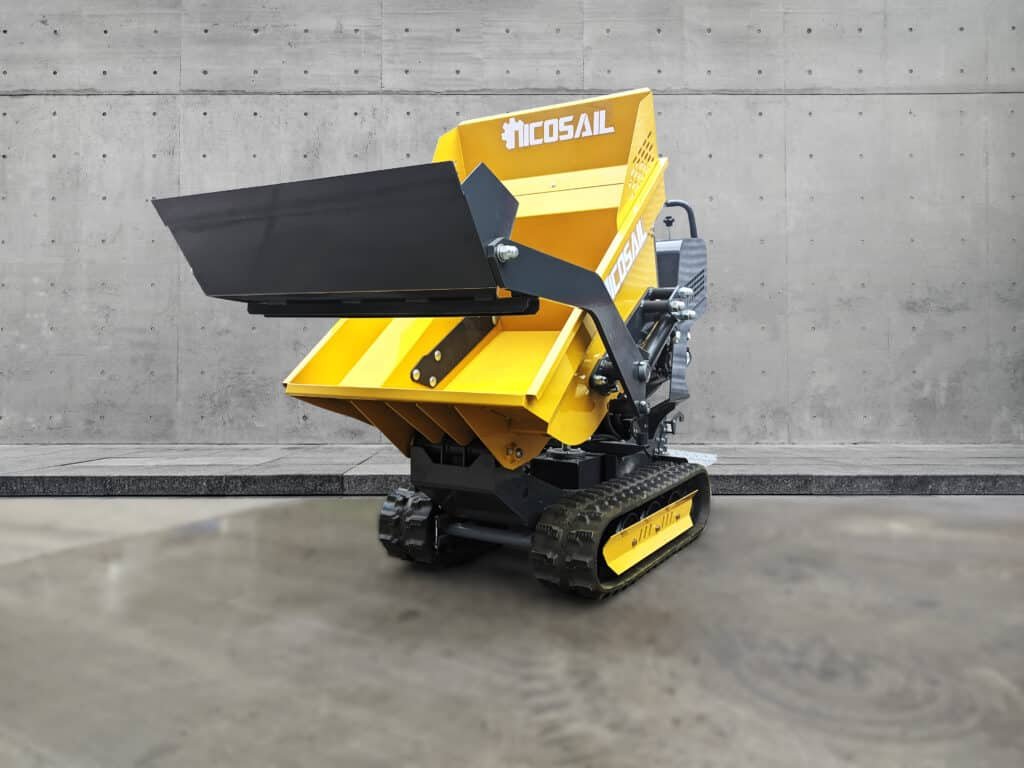
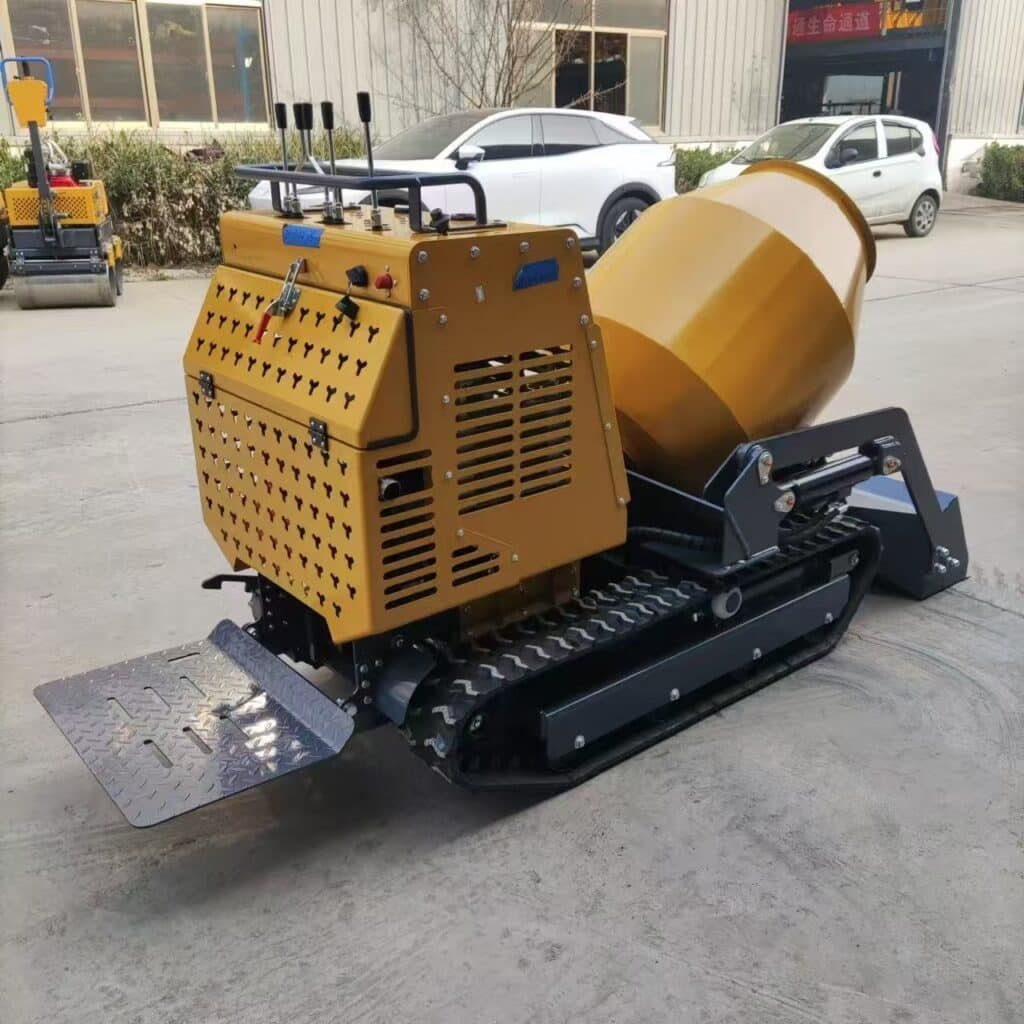
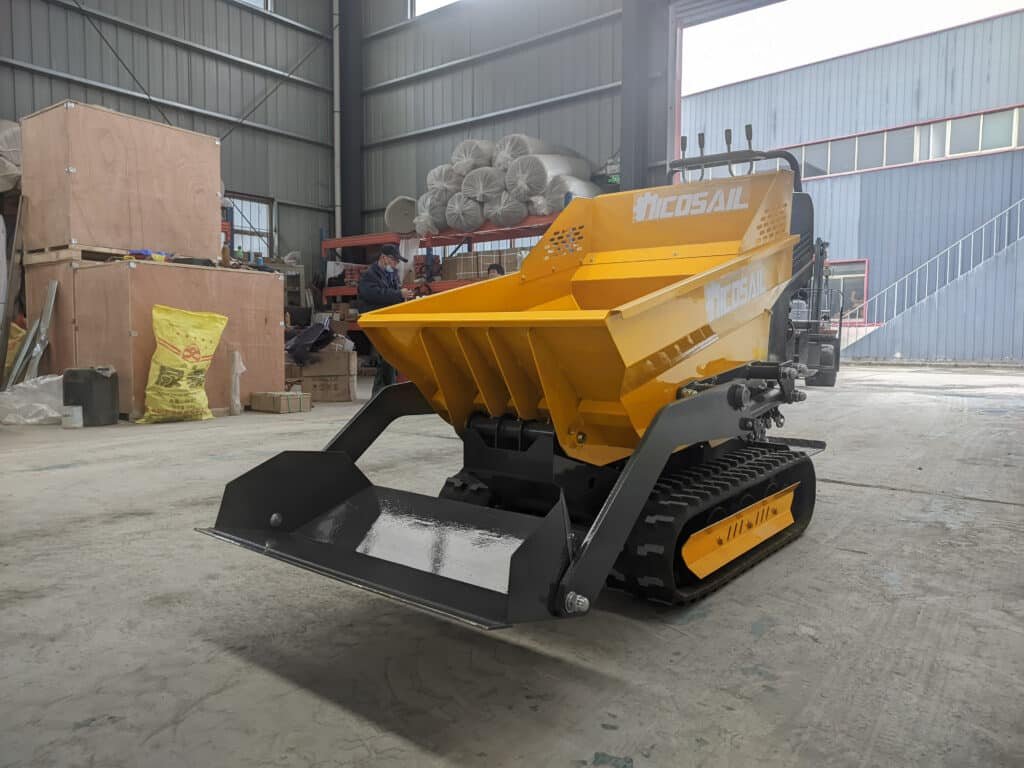
A Chinese mini dumper is designed for carrying material in places where bigger machines are too large, too heavy, or too expensive. It can be wheeled or tracked, manual tip or hydraulic tip, walk-behind or ride-on, simple mechanical drive or more advanced hydraulic drive.
For many small sites, the mini dumper is the middle choice between hand labor and a skid steer.
It does not replace every loader. It does not grade like a skid steer. It does not lift pallets like a telehandler. But for moving material repeatedly, it can be very efficient.
Why Mini Dumpers Often Pay Back Quickly
The payback comes from reducing trips and reducing fatigue.
One mini dumper can often carry much more than a wheelbarrow. It can move through narrow paths, enter garden gates, climb moderate slopes, and travel over rough ground better than hand tools. Tracked models can work well on soft soil, mud, and uneven areas.
For small contractors and landscapers, this means fewer workers may be needed for carrying work. The same workers can spend more time on skilled tasks such as laying blocks, preparing foundations, building fences, planting, or finishing surfaces.
Jobs Where Mini Dumpers Are Strong
Mini dumpers are especially useful for:
Moving soil from excavation
Transporting gravel and sand
Carrying bricks, stones, and blocks
Removing demolition waste
Moving concrete on small sites
Transporting firewood
Farm feeding and manure work
Landscaping and garden renovation
Working behind houses or through narrow access
The machine is simple, but the value is practical. It saves legs, backs, time, and repeated manual effort.
What Buyers Should Not Expect
A mini dumper is not a skid steer. It is mainly a transporter.
It usually cannot load itself unless equipped with a self-loading shovel, and even then, loading ability is limited compared with a skid steer. It is not designed for heavy grading, high lifting, or strong pushing work.
The right expectation is important. A mini dumper pays back fast when the main work is carrying, not when the main work is loading, digging, grading, or lifting.
Skid Steer: Powerful but Not Always the Fastest Payback
A skid steer loader is a powerful compact machine. It can load, push, grade, lift, sweep, trench, drill, break concrete, and use many attachments. On a busy construction or rental site, it can be very valuable.
But for small jobs, it may not always pay back faster.
Advantages of a Skid Steer
The skid steer is versatile. With the right attachment, it can do many jobs. It can load trucks, level ground, dig, carry pallets with forks, clean sites, and work quickly in open areas.
For contractors who already have enough work for it, a skid steer can be a money-making machine.
Disadvantages of a Skid Steer
The biggest issue is cost.
A skid steer usually costs much more than a mini dumper. It also needs more transport planning, more fuel, more maintenance, and more operator skill. It may damage soft lawns or finished surfaces if used carelessly. In very narrow access areas, it may not enter at all.
For a buyer whose main job is only moving soil or gravel from a backyard to a skip, a skid steer may be too much machine.
When a Skid Steer Pays Back Fastest
A skid steer pays back fastest when it is used often and for many different tasks.
For example:
Daily construction use
Earthmoving and grading
Attachment work
Loading trucks
Rental fleet use
Site preparation
Demolition cleanup
Commercial landscaping
If the machine has enough working hours, its higher cost can be justified. If it works only occasionally, payback becomes slow.
Mini Dumper vs Wheelbarrow vs Skid Steer: Practical Comparison
Purchase Cost
The wheelbarrow is cheapest. The mini dumper is higher, but still much lower than a skid steer. The skid steer is the most expensive option.
For buyers with limited budget, the mini dumper is often the first step from manual labor to mechanized work.
Labor Saving
The wheelbarrow saves little labor. It still depends on human pushing and lifting.
The mini dumper saves much more labor because it carries heavier loads with less physical effort.
The skid steer saves labor in more types of work, especially loading and grading, but only if the site can use it properly.
Access in Narrow Areas
The wheelbarrow is very good for narrow access.
The mini dumper is also strong in this area, especially compact tracked models.
The skid steer may struggle with narrow gates, tight paths, small gardens, or indoor access.
Ground Pressure and Surface Damage
A wheelbarrow usually causes little damage, but repeated trips can mark soft ground.
A tracked mini dumper spreads weight better and can work on softer ground.
A skid steer can damage lawns, paving edges, and soft surfaces, especially when turning.
Loading Ability
A wheelbarrow must be loaded by hand or by another machine.
A standard mini dumper also needs loading by hand, excavator, loader, or shovel. Some models have self-loading buckets, but capacity and speed are limited.
A skid steer can load itself and other machines. This is a major advantage.
Maintenance
A wheelbarrow needs almost no maintenance.
A mini dumper needs engine, transmission or hydraulic, track or tire, grease, and basic service.
A skid steer needs more maintenance, more parts, more hydraulic care, and more skilled repair.
Operator Skill
A wheelbarrow needs basic physical ability.
A mini dumper is easier to learn than a skid steer, but still needs safe operation.
A skid steer needs more training, especially around workers, slopes, attachments, and tight spaces.
Payback Speed
There is no single answer for every buyer.
A wheelbarrow pays back fastest for very small and rare jobs.
A Chinese mini dumper often pays back fastest for repeated material transport on small sites.
A skid steer pays back fastest when it has enough work across many tasks.
Which Jobs Suit Each Option Best?
Best Jobs for a Wheelbarrow
A wheelbarrow suits light-duty, short-distance, low-frequency work. It is good when budget is very limited or when the job area is too delicate for machines.
Typical users include homeowners, garden owners, and very small repair teams.
Best Jobs for a Chinese Mini Dumper
A Chinese mini dumper suits buyers who move heavy materials regularly but do not need a large loader.
Typical users include landscapers, small builders, renovation teams, farmers, estate owners, fencing contractors, and groundworkers.
It is especially useful where access is narrow and material movement is repeated many times per day.
Best Jobs for a Skid Steer
A skid steer suits contractors who need strong loading, grading, attachment work, and daily machine use.
Typical users include construction companies, rental companies, demolition contractors, larger landscapers, and site preparation teams.
It is better when job value is high enough to justify the machine cost.
Hidden Costs Buyers Often Forget
Labor Fatigue
Fatigue is a real cost. Workers moving heavy materials by wheelbarrow become slower during the day. Tired workers are also more likely to make mistakes or suffer injury.
A mini dumper reduces this hidden cost.
Transport Cost
A wheelbarrow is easy to transport. A mini dumper usually needs a trailer, van, or small truck. A skid steer often needs heavier transport.
Before buying, the buyer should check machine weight, loading ramps, trailer capacity, and local transport rules.
Storage
Wheelbarrows need little space. Mini dumpers need secure storage. Skid steers need larger storage and better theft protection.
Maintenance Parts
Mini dumpers and skid steers both need parts. For mini dumpers, common parts may include tracks, belts, filters, cables, hydraulic hoses, batteries, seals, and bearings.
A buyer should check parts availability before purchase, not after breakdown.
Downtime
Downtime can be more expensive than parts. If a machine stops during a busy job, workers may wait, rental equipment may be needed, or the job may be delayed.
This is why supplier support matters.
Nicosail pays attention to export preparation, basic spare parts support, packaging, and machine matching because many buyers are far from the factory. For overseas buyers, clear communication before shipment can prevent many small problems later.
How to Calculate Payback in a Simple Way
A buyer does not need a complicated financial model. A simple calculation is enough for a first decision.
Step 1: Estimate Current Labor Cost
Check how many workers are moving material now and how many hours they spend.
For example, if two workers spend three hours per day moving soil, that is six labor-hours per day.
Step 2: Estimate Labor Saved
If a mini dumper reduces that work from six labor-hours to two labor-hours, it saves four labor-hours per day.
The exact number depends on material, distance, slope, loading method, and operator skill.
Step 3: Multiply by Work Days
If this saving happens many days per month, the payback becomes faster. If it happens only once every few months, payback is slower.
Step 4: Add Other Value
Other value may include:
Finishing jobs earlier
Accepting more jobs
Reducing worker injury risk
Reducing rental cost
Improving team morale
Moving heavier material safely
Working in muddy or tight areas
These benefits are harder to calculate, but they matter in real life.
Step 5: Compare Total Ownership Cost
The purchase price is only one part. Add shipping, import cost, spare parts, maintenance, fuel, batteries, tires or tracks, and storage.
A good machine is not always the cheapest one. A slightly better machine with better support may pay back faster because it loses fewer working days.
Common Buying Mistakes
Mistake 1: Buying Only by Price
The cheapest mini dumper may not be the cheapest to own. Thin steel, weak hydraulics, poor welding, low-grade tracks, bad paint preparation, and poor wiring can create problems after real use.
Price matters, but reliability matters more when the machine must work every week.
Mistake 2: Choosing the Wrong Capacity
Some buyers choose too small a dumper to save money. Then the machine works overloaded every day.
Other buyers choose too large a machine and later find it cannot pass through gates or fit on the trailer.
The right machine should match load weight, site width, slope, ground type, and transport method.
Mistake 3: Ignoring Ground Conditions
Wheeled dumpers can work well on firm ground. Tracked dumpers are often better on soft soil, mud, slopes, and uneven construction areas.
For garden and landscaping work, tracked models are often more stable and less likely to sink.
Mistake 4: Forgetting Loading Method
A dumper carries material, but something must load it.
If loading by shovel, the dumper height should be comfortable. If loading by mini excavator, skip shape and width matter. If self-loading is required, the buyer should check how much the self-loading bucket can realistically handle.
Mistake 5: Not Checking Tipping Method
Some dumpers use manual tipping. Others use hydraulic tipping. Hydraulic tipping is easier for heavy loads and daily work.
For occasional light use, manual tipping may be acceptable. For construction, farm, and landscaping use, hydraulic tipping usually brings better productivity.
Mistake 6: Ignoring After-Sales Support
A machine is not only a purchase. It is a working tool. Buyers should check whether the supplier can provide parts, photos, videos, manuals, and technical help.
Good support is part of payback.
How to Choose the Right Chinese Mini Dumper
Choose Tracked or Wheeled Design
A wheeled mini dumper is simple and efficient on firm ground. It can be suitable for paved areas, yards, and lighter work.
A tracked mini dumper gives better traction and stability on soft, muddy, sloped, or uneven ground. It is often preferred for construction, landscaping, and farm use.
Choose the Right Load Capacity
Capacity should match daily work, not only the largest possible job. A machine that is overloaded every day will wear faster.
Buyers should consider the weight of wet soil, stone, concrete waste, and gravel. These materials can be much heavier than expected.
Check Skip Size and Shape
The skip should match the material. Soil and gravel need a strong skip. Blocks and firewood may need easy loading height. Demolition waste may need good protection against dents and sharp edges.
Consider Hydraulic Tipping
Hydraulic tipping is useful when loads are heavy or frequent. It reduces operator strain and speeds up unloading.
For professional users, hydraulic tipping often helps payback.
Check Drive System
Simple mechanical drive can be easy to maintain. Hydraulic drive may offer smoother control. The right choice depends on budget, service ability, and working conditions.
Check Safety Features
Important safety points include stable braking, clear controls, emergency stop where applicable, strong track or tire quality, safe tipping movement, and good operator position.
A mini dumper is small, but it still carries heavy material. Safety should not be ignored.
Match the Machine to Transport
Before ordering, the buyer should check machine width, height, length, and weight. It should fit the trailer, van, ramp, or container plan.
A machine that is difficult to move between jobs may reduce payback.
Supplier Advice Before Ordering from China
Buying a Chinese mini dumper can be a good decision, but supplier selection is important.
Ask for Clear Specifications
The buyer should ask for:
Rated load capacity
Machine weight
Engine type
Track or tire specification
Skip volume
Tipping method
Drive system
Overall dimensions
Packing dimensions
Spare parts list
Photos or videos of the actual machine before shipment
Clear information reduces buying risk.
Ask About Customization
Some buyers need color, logo, packaging, tire type, track type, engine choice, or attachment changes. Customization should be confirmed before production.
Nicosail can support appearance customization and export communication for buyers who need machines prepared for local markets or business use. Customization should always be practical, not only cosmetic.
Check Packaging
Mini dumpers are compact, but they still need careful export packaging. Loose parts, exposed controls, paint surfaces, batteries, hydraulic hoses, and tracks should be protected during shipment.
Poor packaging can turn a good machine into a problem before it reaches the buyer.
Confirm Spare Parts
A buyer should not wait until a breakdown to ask about parts. Basic wear parts should be available. For professional users, ordering common spare parts together with the machine can be sensible.
Judge Communication Quality
Good suppliers explain limits honestly. They do not only say “yes” to every request. A reliable supplier should help the buyer choose the correct size, track type, tipping method, and configuration.
For overseas buyers, communication is not a small detail. It affects the whole buying experience.
9. FAQ
Is a Chinese mini dumper better than a wheelbarrow?
A Chinese mini dumper is better when material movement is frequent, heavy, or tiring. A wheelbarrow is still suitable for light, occasional, short-distance work. For regular construction, landscaping, or farm jobs, a mini dumper usually saves much more labor.
Does a mini dumper pay back faster than a skid steer?
It can pay back faster when the main job is carrying material in narrow or small areas. A skid steer costs more and needs more work hours to justify its price. If the job also requires loading, grading, lifting, and many attachments, a skid steer may pay back better.
What kind of buyer should choose a mini dumper?
A mini dumper suits landscapers, small builders, farmers, garden contractors, renovation teams, fencing teams, and property owners who move soil, gravel, sand, blocks, firewood, or waste regularly.
Should a buyer choose a tracked mini dumper or wheeled mini dumper?
A tracked mini dumper is usually better for soft ground, mud, slopes, and uneven sites. A wheeled mini dumper can be suitable for firm, flat, and paved areas. The ground condition should decide the choice.
Is hydraulic tipping necessary?
Hydraulic tipping is not always necessary, but it is very useful for heavy or frequent loads. It reduces physical strain and improves unloading speed. For professional use, hydraulic tipping is usually worth considering.
Can a mini dumper load itself?
Some mini dumpers have a self-loading shovel, but the loading ability is limited compared with a skid steer. Buyers should not expect a mini dumper to perform like a full loader.
What is the biggest mistake when buying a mini dumper?
The biggest mistake is choosing only by price without checking capacity, ground condition, tipping method, parts support, and real job requirements. A machine that does not match the work will not pay back quickly.
Can a mini dumper work on slopes?
Many tracked mini dumpers can work on moderate slopes, but safe operation depends on load weight, ground condition, machine design, and operator behavior. Heavy loads on steep or uneven slopes increase risk. The operator should always follow the supplier’s safety guidance.
What should be checked before importing from China?
Buyers should confirm specifications, dimensions, shipping method, packaging, spare parts, warranty terms, photos or videos before shipment, and supplier communication process.
How does Nicosail help buyers reduce risk?
Nicosail helps buyers by discussing machine matching, configuration, appearance customization, export packaging, and basic after-sales support before shipment. For overseas buyers, this kind of preparation can reduce mistakes and improve long-term machine value.
10. Final Conclusion
The fastest payback choice depends on the work.
A wheelbarrow pays back fastest for very small, light, occasional jobs because the purchase cost is low. But when material movement becomes frequent and heavy, labor cost quickly becomes the real expense.
A skid steer is powerful and versatile. It can pay back well for contractors who use it often for loading, grading, lifting, cleaning, and attachment work. But for simple material transport in narrow areas, it may be too expensive and too large.
A Chinese mini dumper often gives the best balance for small construction sites, landscaping jobs, farms, gardens, and renovation work. It costs more than a wheelbarrow but saves much more labor. It costs much less than a skid steer but can handle many daily carrying jobs that make workers tired and slow.
The best choice is not the biggest machine or the cheapest tool. The best choice is the one that matches the real job: material weight, travel distance, ground condition, site access, loading method, operator skill, and work frequency.
For buyers who move heavy materials again and again, a well-chosen Chinese mini dumper can pay back faster than expected. It reduces fatigue, improves site speed, and helps small teams complete more work with less physical strain.