1. What Exactly Is a Chinese Mini Dumper – And Why Renters Love Them
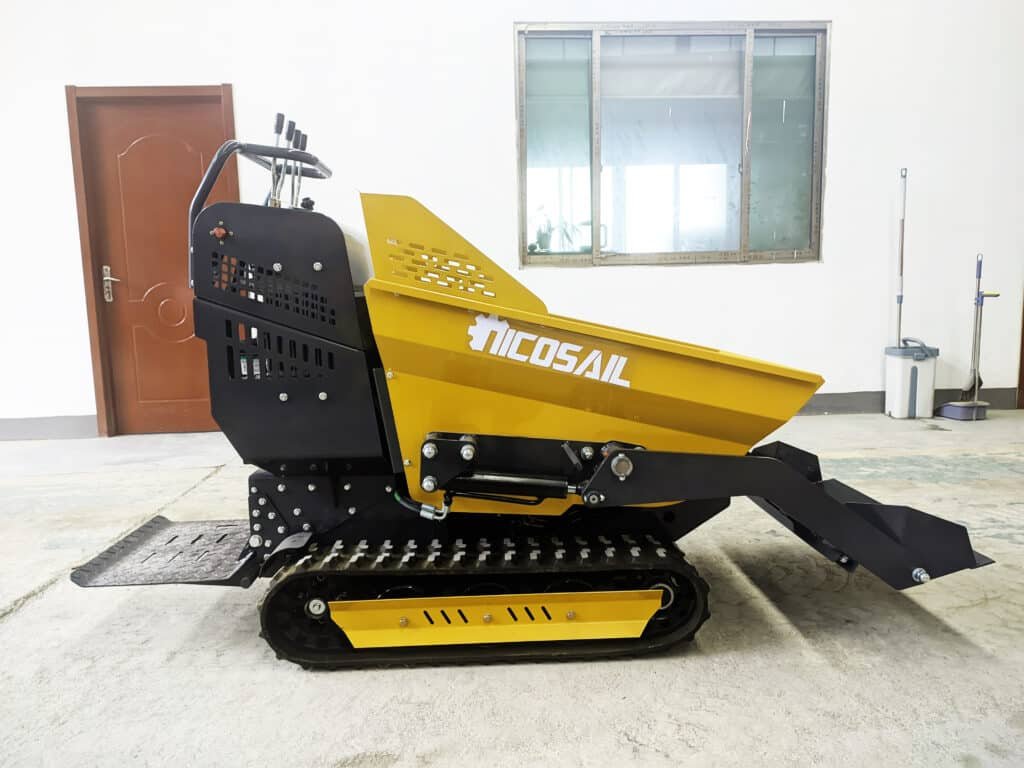
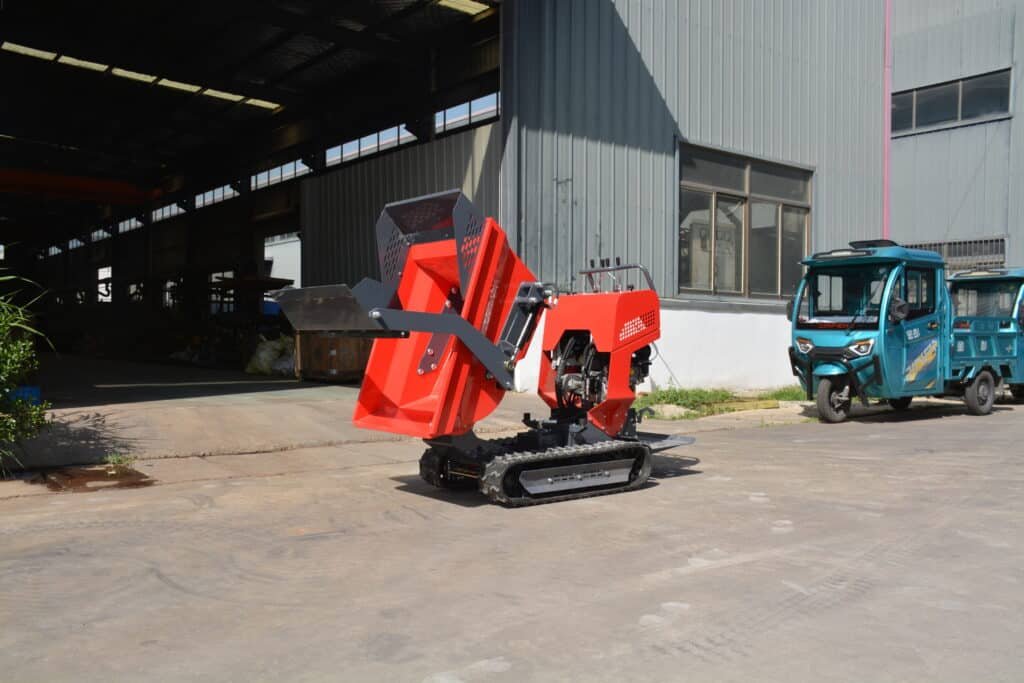
Mini dumpers (sometimes called “power barrows” or “site dumpers”) are compact machines designed to move soil, gravel, debris, or materials over short distances. Think of them as a motorized wheelbarrow that saves a lot of back pain.
Most Chinese mini dumpers in the rental market are:
- Payload: 300–1,000 kg
- Drive: Tracked or wheeled
- Power: Small diesel or gasoline engines
- Use cases: Tight job sites, gardens, basements, urban construction, landscaping, small demolition work
For rental customers, mini dumpers are attractive because:
- They save labor – two workers with a mini dumper can often replace three or four people with wheelbarrows.
- They work in tight spaces where larger dumpers or loaders cannot enter.
- They are easy to learn – basic training in 10–15 minutes.
- They are versatile – construction, landscaping, agriculture, municipal works.
For rental fleet owners, Chinese mini dumpers are interesting because:
- Purchase price is significantly lower than many European/Japanese/US brands.
- The machines are simple, so parts and repairs are manageable.
- If selected correctly, they can reach payback within one season in many markets.
But all this only happens if utilization, damage control and ROI are managed properly.
2. Where Mini Dumpers Fit in a Rental Fleet
Mini dumpers rarely stand alone. They usually sit next to mini excavators, skid steer loaders, compact tracked loaders and small compaction machines. Typical customers:
- Landscape contractors – moving soil, mulch, stones.
- Small builders – foundation work, renovation, basements.
- Rental for homeowners – garden projects, driveway works.
- Agriculture users – feed, manure, general farm materials.
Good rental fleets use mini dumpers as a “companion product”:
- Customer rents a mini excavator → offer a mini dumper as an add-on.
- Customer rents a plate compactor for a patio → offer a mini dumper to move materials.
This cross-rental approach dramatically improves utilization because the dumper “rides along” with more popular machines.
Chinese brands (such as Nicosail) also usually offer matching mini excavators and mini dumpers with similar transport dimensions. That makes logistics easier: machines fit together on typical trailers and small trucks.

3. Utilization: The Heart of Mini Dumper Profitability
Good Utilization Targets
Utilization is simply:
Rental days per year ÷ 365
For mini dumpers, good annual utilization for a healthy rental business is often:
- 50–65% (around 180–240 rental days per year) for well-managed fleets
- 30–40% (about 110–150 days) if the dumper is just “sitting there” with no bundling or promotion
Higher purchase price machines usually require higher utilization to justify the investment.
For Chinese mini dumpers, because the purchase price is lower, even 150 days per year can still give a very good payback, as long as the daily rate and maintenance costs are under control.
Seasonality and Machine Mix
Mini dumper utilization is very seasonal in many countries:
- Spring & summer: peak – landscaping, outdoor building, DIY projects
- Autumn: medium – some construction, garden clean-ups
- Winter: low – except mild climates or indoor/basement jobs
To keep utilization healthy:
- Avoid buying too many units at once; grow step by step.
- Mix payload sizes – for example:
- Small 300–500 kg tracked units for gardens and narrow gates
- 800–1,000 kg units for professional construction sites
- Mix tracking types:
- Tracked mini dumpers for muddy, soft ground
- Wheeled units for hard surfaces, concrete, and indoor use
Practical Tips to Keep Mini Dumpers Out on Rent
- Bundle with excavators.
Offer a reduced rate when the mini dumper is rented together with a mini excavator. Customers often say yes if it saves labor. - Show on the website as a “helper”.
On product pages for mini excavators or small loaders, clearly show “recommended with this machine: mini dumper”. - Weekend and DIY packages.
For homeowner markets, offer Friday-to-Monday packages at a fixed price, with clear photos and use cases. - Transport made simple.
Make sure the machine fits easily on common trailers/vans, and show photos of how to tie it down. If the customer sees logistics as “easy”, rental probability goes up. - Educate counter staff.
Many rental opportunities are lost at the front desk. Staff should always ask: “Do you also need to move the soil/stones? A mini dumper will save a lot of time.”
4. Choosing the Right Chinese Mini Dumpers for Rental Use
The right spec is critical. Rental machines must be:
- Sturdy
- Simple
- Easy to maintain
- Safe
- Certified for local regulations
Payload, Size and Body Design
Key decisions:
- Payload class
- 300–500 kg: light, garden, DIY, narrow gates
- 800–1,000 kg: contractor, construction, heavier loads
- Skip/body type
- Straight tipping skip – simple, cheap, good for general material
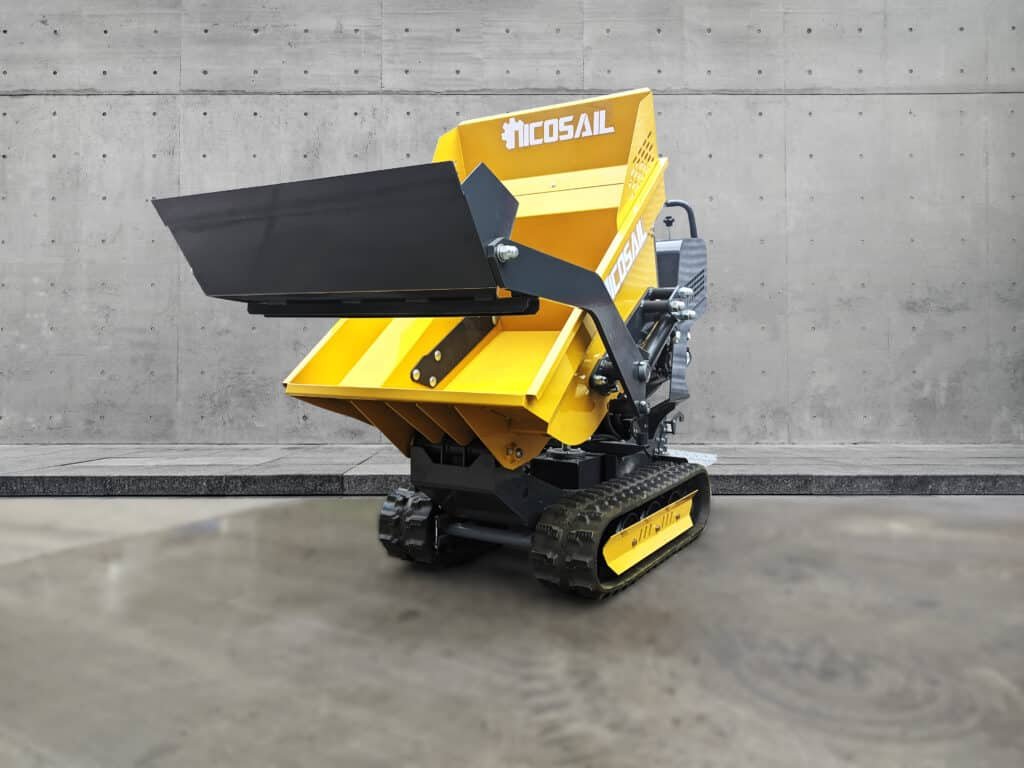
- High-lift skip – tips into trucks or containers; more complex but more versatile
- Swivel skip – useful on tight sites, reduces the need to maneuver
For rental fleets, the 500–1,000 kg range with standard tipping skip is often the best balance of cost, utilization and durability.
Engine, Hydraulics and Transmission
Chinese mini dumpers in this class are mostly:
- Small diesel or gasoline engines from common brands
- Hydrostatic or mechanical drive
- Simple hydraulic circuits for skip lifting
For rental purposes:
- Prefer widely available engine brands in your market (easier parts and service).
- Make sure the air filter and fan are easy to access and clean.
- Check that hoses are protected from branches and debris, especially around the tracks.
Brands like Nicosail typically design rental-focused models with:
- Protected routing of hydraulic hoses
- Accessible service points
- Simple gear or hydrostatic systems sized for continuous duty
Simple machines break less, which is exactly what a rental fleet needs.
Tracks vs Wheels
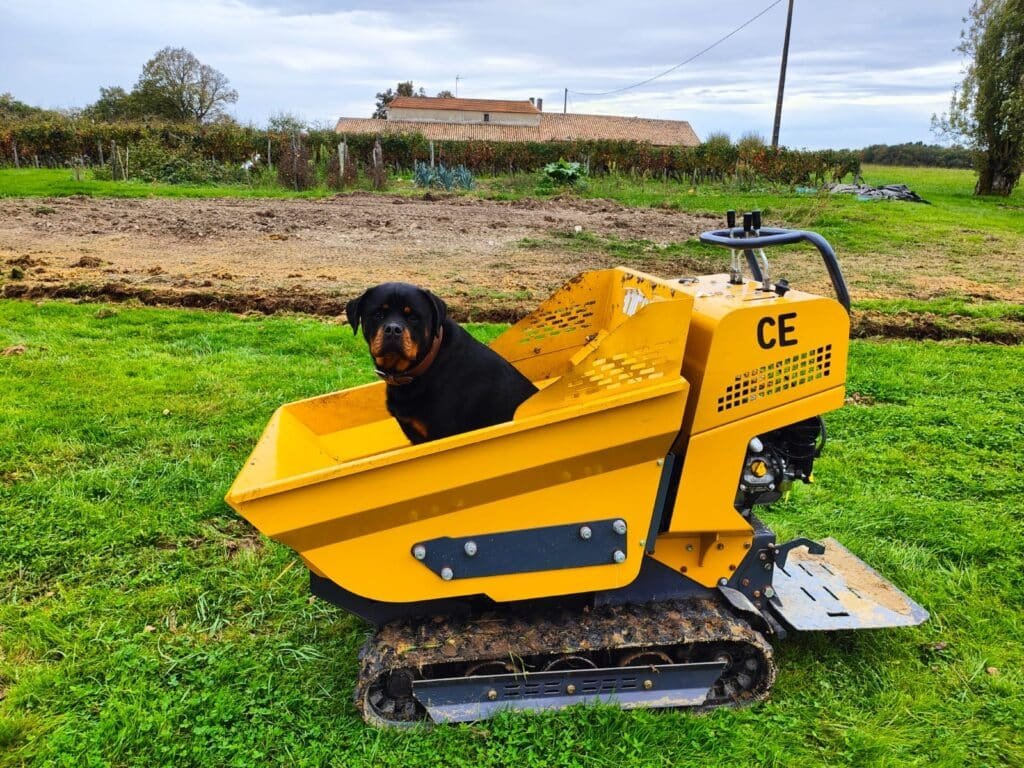
Tracked mini dumpers:
- Better on mud, slopes and soft ground
- Gentler on turf
- More expensive undercarriage wear, but also higher utilization on tough sites
Wheeled mini dumpers:
- Cheaper to maintain tyres than track systems
- Better on concrete and paved surfaces
- May slip in mud or on steep slopes
Many rental fleets start with tracked units, because they cover more job types (construction, landscaping, agriculture). Later, wheeled units can be added for more specialized use.
Safety, CE/ISO and “Paperwork”
For Europe, North America, Australia and similar markets, proper certification matters:
- CE marking and relevant EN standards (for EU/EEA)
- Declaration of Conformity
- Clear operator’s manual in the customer’s language
- Load and safety labels, emergency stop, guards on moving parts
When evaluating a Chinese supplier:
- Request sample documents (CE Declaration, manuals, risk assessment if available).
- Check that the labels on the machine match the paperwork.
- Make sure the supplier can customize manuals and decals with your language and brand.
Working with Brands Like Nicosail
Some Chinese factories, such as Nicosail, position themselves specifically for foreign rental and dealer markets. Typical advantages:
- Willing to customize colors, decals and branding, which is helpful for rental companies and re-branders.
- Understand the need for consistent spare parts, not “random” component changes every few months.
- Provide testing data, photos, and videos to help with your internal quality checks.
For a rental fleet, the machine must survive rough daily use. A factory with experience building for rental customers usually reinforces:
- Skip pivot points
- Undercarriage and rollers
- Control levers and guards
These details make a big difference in lifecycle cost and uptime.
5. Damage, Breakdowns & Who Pays: Deposits vs Damage Waivers
Mini dumpers live a hard life. They load rocks, drive over rubble, and are often used by inexperienced operators. Damage management is not optional – it is part of the business model.
Typical Damage on Mini Dumpers
Common issues:
- Bent skip edges or dented body
- Damaged tracks or tyres from curbs, steel debris, rebar
- Broken control levers and throttle cables
- Hydraulic hose cuts or leaks
- Over-loading leading to cracked welds or bent frames
Some of this is wear and tear, some is abuse or negligence. A good rental contract must separate the two.
Classic Deposit Model
The basic approach:
- Customer pays a refundable deposit.
- After the rental, the machine is inspected.
- Damage beyond normal wear is charged, and the balance of the deposit is returned.
Pros:
- Simple to explain
- Works fine with repeat professional customers
Cons:
- Deposit is often too small to cover serious damage (e.g., broken tracks, structural cracks).
- Customers may be unhappy with big bills at the end.
- Staff may feel pressure not to charge full damage cost.
Damage Waiver / LDW (Loss Damage Waiver) Model
Many rental companies now use a damage waiver or LDW:
- Customer pays an extra fee (percentage of rental rate).
- In return, the rental company waives part of the repair cost in case of damage, up to agreed limits.
- Customer still pays for abuse, theft without police report, or gross negligence – but not for every scratch.
For example:
- Damage waiver fee: 10–15% of the base rental rate
- Waiver: the customer is only responsible for a deductible (e.g., first $200–$500 of damage)
- Everything above that is covered by the waiver (or insurance, depending on local law)
This model:
- Creates a predictable cash flow to cover average damage.
- Reduces conflict when damage happens.
- Allows a lower deposit, which customers like.
How to Price a Damage Waiver
There is no magic number, but a simple way to start:
- Look at average annual damage cost per dumper over a season (tracks, weld repairs, hoses, body work).
- Estimate average annual rental revenue per dumper.
- Set the waiver fee so that, on average, damage waiver income covers typical damage plus a safety margin.
Example calculation idea (rounded):
- Average annual damage cost per dumper: $400
- Average annual rental revenue per dumper: $8,000
- Damage cost is 5% of revenue → set damage waiver at 10–12% of base rental rate.
This way, over a fleet, damage waiver income should cover damage and still leave profit.
Inspection, Photos and Documentation
A damage waiver system only works if inspections are serious:
- Pre-rental checklist – photos from all sides, undercarriage, controls, hour meter.
- Post-rental checklist – same angles, plus close-ups of any damage.
- Digital tools (mobile apps, simple shared folders) make this easy.
Clearly define what is:
- Normal wear and tear – scratches, minor paint chips, expected track/tyre wear.
- Chargeable damage – bent structure, cracked welds, missing parts, deep dents.
Write it into the rental terms so staff know how to apply it consistently.
6. The Numbers: Simple ROI Model for a Mini Dumper Fleet
Now to the part most owners care about: return on investment (ROI).
Key Inputs to Track
To understand dumper profitability, track for each model:
- Purchase price (machine + freight + import charges)
- Average rental days per year
- Daily rental rate (or weekly/monthly equivalents)
- Variable costs:
- Fuel (if included), wear parts, repairs, damage
- Fixed cost allocation:
- Storage, insurance, depreciation, management
- Resale value after X years
Even an approximate model is better than guessing.
Step-by-Step ROI Example: Chinese vs Higher-Priced Brand
Assume two similar mini dumpers:
- Chinese mini dumper (e.g., from Nicosail or similar):
- Purchase cost: $5,000
- Higher-priced brand (European/Japanese):
- Purchase cost: $9,000
Other assumptions (same for both):
- Average utilization: 150 days/year
- Daily rate: $80
- Variable + damage + overhead cost: 30% of rental revenue
- Resale value: ignore for now (for simplicity) – just focus on payback time.
Step 1 – Annual Rental Revenue
Rental days per year: 150
Daily rate: $80
Multiply 150 × 80:
- 15 × 8 = 120
- Add two zeros (because 150 and 80 each have one zero): 12,000
So annual rental revenue per dumper = $12,000
Step 2 – Annual Gross Margin (after 30% costs)
Cost ratio = 30% → margin = 70%
70% of 12,000 = 12,000 × 0.7
- 12,000 × 7 = 84,000
- Divide by 10 → $8,400
So annual gross profit per dumper ≈ $8,400
Step 3 – Payback Period
Chinese dumper ($5,000):
Payback time = purchase cost / annual gross profit
5,000 ÷ 8,400 ≈ 0.6 years (about 7–8 months of average utilization).
Higher-priced dumper ($9,000):
9,000 ÷ 8,400 ≈ 1.07 years (about 13 months).
Both can be profitable, but:
- The Chinese dumper pays back faster.
- After the first season, cash flow from the Chinese dumper can already contribute to buying more machines or covering slow months.
If resale value is added (for example, selling the dumper after 4–5 years), the financial picture improves further. But even with this very simple model, it is clear that:
Shorter payback on Chinese machines gives more flexibility and less risk.
Of course, this only works if the dumper is reliable. That is why careful supplier selection is essential.
Sensitivity: What if Utilization Drops?
Now consider a weaker year: 100 rental days instead of 150.
- 100 × 80 = $8,000 revenue
- 70% margin → 8,000 × 0.7
- 8,000 × 7 = 56,000
- ÷10 = $5,600 gross profit
Now, payback time:
- Chinese dumper: 5,000 ÷ 5,600 ≈ 0.9 years (about 10–11 months)
- Higher-priced dumper: 9,000 ÷ 5,600 ≈ 1.6 years (about 19 months)
In a slow year, the advantage of a lower-cost Chinese dumper becomes even more obvious.
7. Operating Playbook: How to Run a Profitable Dumper Rental Line
Even the best ROI model fails if daily operations are messy. A few simple habits protect profit.
Check-Out & Check-In Routines
At check-out:
- Walk around the machine with the customer.
- Show existing scratches and dents.
- Take photos (4 sides + undercarriage + hour meter).
- Explain basic controls and daily checks.
At check-in:
- Repeat the walk-around.
- Compare with the check-out photos.
- Note new damage in writing and with photos.
- Decide whether damage is:
- Wear and tear
- Chargeable damage under the contract
This routine reduces disputes and trains customers to treat machines better.
Short Training for Renters
Most damage comes from inexperienced operators. A short, simple training at check-out goes a long way:
- How to start and stop safely
- How to drive on slopes (straight up/down, not sideways)
- Maximum load level in the skip
- Where not to drive (sharp rebar, big rocks, deep mud)
- Use of parking brake and key removal
Many Chinese mini dumpers, including those from Nicosail, have straightforward controls. A 10-minute explanation can prevent hundreds of dollars in damage.
Maintenance and Spare Parts Strategy
A rental mini dumper is like a tool: it must be available.
Simple practices:
- Daily checks – engine oil, fuel, visual leaks, tracks/tyres.
- Weekly checks – grease points, air filter, hydraulic oil level.
- Service by hours – follow the engine and hydraulic service intervals.
Keep basic parts in stock:
- Filters (oil, fuel, air)
- Hydraulic hoses in common sizes
- Tracks or tyres for the main models
- Throttle and control cables
When working with a Chinese supplier:
- Ask for a recommended spare parts list for 1–2 years of rental use.
- Make sure part numbers stay stable over time.
- Choose suppliers like Nicosail who commit to long-term parts support for each model.
When to Sell and Renew Machines
At some point, a dumper becomes:
- Too worn to look good on the yard
- Too unreliable (frequent breakdowns)
- Too old to match your brand image
Rental fleets often sell machines when:
- Repair costs per year begin to rise sharply
- An upcoming repair (e.g., new tracks, major structural repair) is more than the machine’s resale value
Chinese mini dumpers with low purchase cost can be sold earlier without hurting ROI. This keeps the fleet looking modern and reliable, which again supports utilization.
8. Working with Chinese Suppliers Without Headaches
Many overseas buyers have had bad experiences: delayed shipments, certificate problems, quality differences between sample and mass production. These risks can be managed with the right approach.
Checking Factory vs Trader
Before committing:
- Ask for factory photos and videos showing welding, painting, assembly, and testing lines.
- If possible, visit the factory or send an independent inspector.
- Check the factory name on the documents matches the actual manufacturer.
Factories like Nicosail, which openly present themselves as manufacturers with multiple production lines, are usually more transparent and easier to control than unknown trading companies.
Quality, Testing and Certificates
Key points to verify:
- Incoming inspection of steel, engines, hydraulic components.
- Welding quality – look at repetitive welds on the chassis and skip.
- Paint and surface preparation – blasting or good pre-treatment prevents rust.
- End-of-line tests – each dumper should be test-run, not just visually checked.
For certificates:
- Request sample CE Declaration, ISO certificates, and test reports.
- Check that model names, serial number formats, and manufacturer names are consistent across:
- Nameplates
- Declarations
- Manuals
False or inconsistent certificates are a serious red flag.
Lead Times, Shipping and Timing
Rental businesses are often sensitive to seasons. Missing the spring peak because machines are stuck in production or customs is painful.
Good practice:
- Confirm realistic production time per batch, not just “fast delivery”.
- Add buffer for shipping, customs, and inland transport.
- For key models, keep some stock units in your own yard.
Factories experienced in export, such as Nicosail, usually have more stable lead times and can suggest shipping schedules aligned with your season.
Red Flags to Avoid
Be careful when:
- The supplier changes key components (like engines or pumps) without notice to “save cost”.
- Certificates are sent only as low-resolution photos and cannot be verified.
- Communication is slow or inconsistent; questions about testing or warranty are answered vaguely.
- The price is far below other serious factories for the same specification.
A slightly higher purchase price from a stable factory can actually produce better ROI than the cheapest option, because downtime and customer complaints are expensive.
9. FAQs
Q1: What is a realistic daily rental rate for a 500–1,000 kg mini dumper?
Rates vary by country and city, but many markets use a daily rate similar to or slightly lower than a 1-ton mini excavator. What matters is that the rate covers the machine cost, expected utilization, damage, and overhead. A quick ROI calculation with local prices will give a clearer answer than copying competitors.
Q2: How many dumper models should a new rental fleet start with?
Often it is better to start with one or two key models: for example, a 500–600 kg tracked dumper for gardens and a 1,000 kg tracked dumper for construction sites. Once utilization is proven and customers ask for more variations (swivel skips, high-lift, wheeled units), additional models can be added.
Q3: Are Chinese mini dumpers reliable enough for heavy rental use?
Reliability depends more on the specific factory and design than on the country. Well-built Chinese machines from experienced manufacturers like Nicosail can handle tough rental conditions when maintained properly. The key is to choose models with reinforced structures, protected hoses, and proven engines, and to follow a simple maintenance plan.
Q4: How long does it usually take to recover the investment in a mini dumper?
With decent utilization (around 150 days per year) and a reasonable daily rate, many fleets recover the purchase cost of a Chinese mini dumper in one season or less. Higher-priced brands may need around one to two seasons. Local rates and damage levels will affect this, so building a simple ROI sheet is strongly recommended.
Q5: Should damage waivers be mandatory or optional for customers?
Some rental companies make damage waivers mandatory for small equipment; others offer them as an optional add-on. Mandatory waivers simplify administration but may face resistance from long-term customers. Optional waivers let the customer choose. In either case, the rules and coverage should be clearly written in the rental agreement.
Q6: How many spare parts should be ordered with the first dumper batch?
A practical approach is to purchase a starter kit of critical parts for 1–2 years: engine filters, hydraulic filters, hoses, tracks or tyres, cables, and key electrical components. The supplier should provide a recommended list and part numbers. This minimizes downtime and avoids expensive express shipments later.
Q7: Is it better to buy from a factory like Nicosail or through a local importer?
Both options can work. Buying directly from a factory such as Nicosail usually offers better pricing and more customization (colors, logos, options). Buying from a local importer may provide faster parts and local service but at a higher price. The right choice depends on your technical capability, order volume, and willingness to manage imports.
Q8: How long should a mini dumper stay in the rental fleet?
Many rental fleets keep mini dumpers for 4–7 years, depending on usage intensity, maintenance quality, and customer expectations. When repair costs increase, appearance declines, or safety standards change, it can be smarter to sell the machine while it still has resale value and replace it with a new one.
10. Final Summary
Running a profitable mini dumper rental fleet is not just about buying cheap machines and hoping for the best. Success comes from combining:
- Smart utilization – bundle with excavators, promote as a helper, plan for seasonality.
- Clear damage management – deposits or damage waivers, supported by photos and consistent rules.
- Solid ROI thinking – track rental days, rates and costs, and use simple payback calculations to guide fleet size.
- Good machine selection – robust, simple Chinese mini dumpers from reliable factories, with proper certification and parts support.
- Disciplined operations – checklists, short operator training, and a basic maintenance program.
Chinese manufacturers such as Nicosail make it possible to enter or expand the mini dumper rental business with competitive purchase prices and machines designed for real job sites, not just showroom floors. With the right models, clear rental terms, and a bit of discipline, mini dumpers can quickly move from “small add-on product” to a steady profit center in any rental fleet.