1. What Exactly Is a “Chinese Mini Dumper” Today?
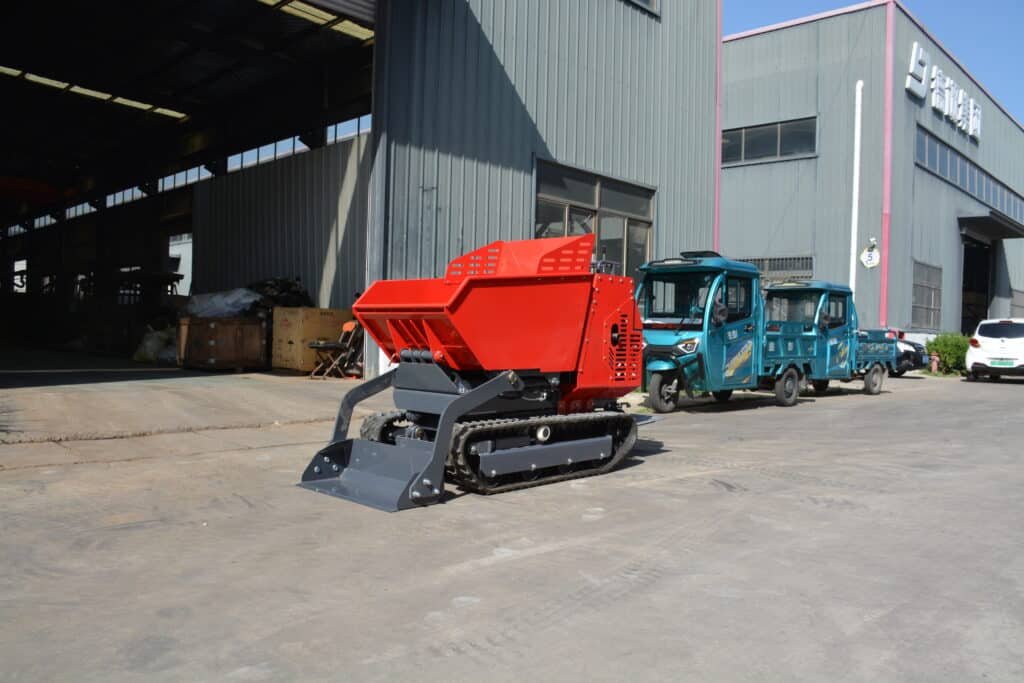
When people say “Chinese mini dumper”, they usually mean compact dumpers built in China, often:
- Payload from about 500 kg to 3 tons
- Tracked or wheeled
- Used for construction sites, farms, landscaping, small demolition, narrow access jobs
Most of them are:
- Simple machines with mechanical or hydraulic tipping buckets
- Powered by a small diesel or gasoline engine
- Operated by levers and simple controls, not much electronics
Over the last 10–15 years, these machines have moved from very basic “cheap alternatives” to something that, if chosen carefully, can be genuinely usable in professional rental fleets and dealer networks.
The big question now is no longer “Can China build it?” but:
Is a Chinese mini dumper worth buying once total cost of ownership (TCO) is added up?
That is exactly what this guide covers.
2. Why Buyers Are Looking at Chinese Mini Dumpers Now
Typical buyers for Chinese mini dumpers include:
- Dealers and distributors building a private-label brand
- Rental companies needing simple, low-cost units
- Contractors and farmers who want more machines within a tight budget
Why so much interest?
- European or Japanese dumpers are often 2–3 times the price
- Many jobs are short-haul, low-risk, where a “Ferrari-level” dumper is overkill
- Chinese factories now offer OEM branding, custom colors, and attachments
- Better access to China suppliers through online platforms and trade shows
So the demand is there, but buyers still worry about:
- Real-world reliability
- Fake certificates
- Late shipments
- After-sales parts
Those concerns are valid. The trick is not to avoid Chinese machines, but to filter and manage them properly.
3. Real-World Pros of Buying a Chinese Mini Dumper
3.1 Lower Purchase Price and Faster Payback
The most obvious advantage: price.
A typical Chinese mini dumper often lands at roughly 40–60% of the cost of a well-known European brand with similar payload. Not exact for every case, but that range is common.
What this means for a dealer or rental company:
- Faster payback period
- Lower capital tied up
- Ability to carry more units in stock
For example (just conceptually):
- If a branded European dumper needs 3–4 seasons of rental to pay back,
- A decent Chinese dumper might pay back in 1.5–2 seasons, even with slightly higher maintenance and lower resale.
For budget-sensitive contractors and farmers, this lower entry cost often means:
- One can buy instead of rent
- Two machines instead of one (one on site, one as backup)
3.2 Simpler Design, Easier Maintenance
Most Chinese mini dumpers are built with simple, proven designs:
- Basic mechanical linkages
- Straightforward hydraulic systems
- Limited electronics
This is not as glamorous as high-end models, but it has clear advantages:
- Local mechanics can understand the system without dealer-specific diagnostic tools
- Spare parts can often be sourced locally (bearings, hoses, filters, etc.)
- Fewer electronic failures and sensor issues
For rental fleets in particular, simple machines often mean:
- Less time explaining controls to users
- Fewer headaches when machines come back damaged or misused
3.3 Custom Colors, Branding, and Options
Chinese factories, especially those focusing on export, usually:
- Accept custom paint colors
- Can add logos, decals, and model labels
- Offer option packages, such as:
- Electric start
- Wider or narrower tracks
- Higher side walls or extended skip
- Headlights or work lights
This is very attractive for:
- Dealers wanting to build a house brand
- Rental companies wanting all machines to share one visual identity
Factories like Nicosail focus exactly on this kind of OEM / ODM cooperation: paint, decals, and even some structural options can be customized so dealers can position the product where they need in their local market.
3.4 Supply Capacity for Dealers and Rental Fleets
Western brands often have:
- Longer lead times
- Limited allocation for small and mid-size dealers
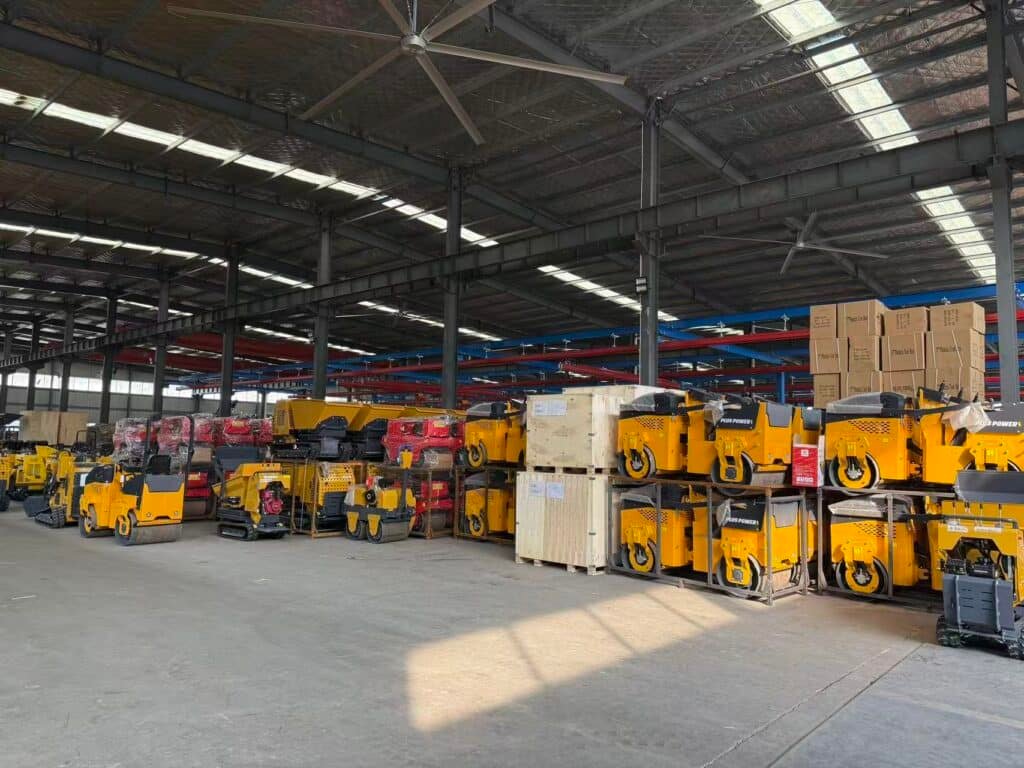
Serious Chinese factories, especially those with multiple production lines (for example, Nicosail with 5 lines), can often:
- Arrange batch orders
- Keep standard models in rolling production
- Ship mixed containers (mini dumpers + mini excavators, etc.)
This helps:
- Dealers manage stock rotations
- Rental companies expand fleets before peak season instead of missing demand
4. Real-World Cons and Risks to Watch Out For
Of course, not everything is positive. There are some very real downsides and risks if selection is not managed carefully.
4.1 Quality Variance Between Factories
China is not one single quality level. There are:
- Top factories with standardized processes, welding procedures, and testing
- Mid-level plants that are acceptable if managed well
- Very basic workshops with almost no quality control
From the outside, photos can look similar. But inside:
- Steel grade can differ
- Weld penetration can vary
- Load testing might be missing
This is why factory audit, sample testing, and third-party inspection are so important.
4.2 Documentation, Certification, and Compliance
For markets in Europe, North America, and Australia, compliance matters:
- CE marking, technical file, manuals
- In some regions, ROPS/FOPS or other safety requirements
- Engine emission compliance (EU Stage V, EPA Tier 4, etc.)
Risks include:
- Fake or incomplete CE documents
- Wrong emission label on engine
- No proper user manual or safety decals
This can create real problems at customs, during inspections, or in case of an accident.
Stronger factories, such as Nicosail, usually maintain:
- Stable engine suppliers with correct certificates
- Finished CE documentation and user manuals in English
- Proper safety labels and plate markings on each machine
Asking directly for sample certificates, manuals, and labels is a good way to test if a supplier is serious.
4.3 Parts Availability and After-Sales Support
Even a good machine will need:
- Filters, belts, and hoses
- Pins and bushings
- Wear parts for tracks and undercarriage
Common problems with weak suppliers:
- No parts catalog
- Slow communication after shipment
- No standardization of components
Better suppliers will:
- Use standard engines and hydraulic components from known brands
- Provide recommended spare parts list for the first two years
- Offer exploded diagrams or parts books
This is where a brand like Nicosail usually tries to differentiate: by keeping parts information and basic stock, and by designing machines around globally available components where possible.
4.4 Brand Perception and Resale Value
One unavoidable downside:
- A Chinese mini dumper usually has lower resale value than a big-name European brand.
For dealers and fleets, this means:
- The machine needs to pay back mainly through use, not resale.
- The business model should assume shorter holding periods or lower resale price.
This is not necessarily a deal-breaker. If purchase price and running cost are low enough, total cost can still be favorable. But it needs to be planned, not ignored.
5. Chinese Mini Dumper TCO: A Simple 5-Year Cost Model
Total Cost of Ownership (TCO) means looking beyond purchase price to include:
- Purchase price
- Shipping, duties, and local setup
- Routine maintenance and repairs
- Downtime cost (lost jobs, rental refunds, etc.)
- Fuel (for many jobs, similar across brands)
- Resale value at the end
Here is a simple illustrative example (numbers are hypothetical, just to show the logic).
Option A: Chinese Mini Dumper
- Purchase: $6,000
- Shipping & duty: $1,500
- Maintenance & repairs: $500 per year
- Downtime cost: $300 per year
- Resale after 5 years: $2,000
Calculation:
- Maintenance over 5 years:
- $500 × 5 = $2,500
- Downtime over 5 years:
- $300 × 5 = $1,500
- Total before resale:
- Purchase + shipping + maintenance + downtime
- $6,000 + $1,500 = $7,500
- $7,500 + $2,500 = $10,000
- $10,000 + $1,500 = $11,500
- TCO after resale:
- $11,500 − $2,000 = $9,500
Option B: European Brand Mini Dumper
- Purchase: $14,000
- Shipping & duty: $1,000
- Maintenance & repairs: $350 per year
- Downtime cost: $150 per year
- Resale after 5 years: $4,500
Calculation:
- Maintenance over 5 years:
- $350 × 5 =
- $300 × 5 = $1,500
- $50 × 5 = $250
- Total = $1,750
- $350 × 5 =
- Downtime over 5 years:
- $150 × 5 =
- $100 × 5 = $500
- $50 × 5 = $250
- Total = $750
- $150 × 5 =
- Total before resale:
- Purchase + shipping + maintenance + downtime
- $14,000 + $1,000 = $15,000
- $15,000 + $1,750 = $16,750
- $16,750 + $750 = $17,500
- TCO after resale:
- $17,500 − $4,500 = $13,000
Result of this hypothetical case:
- Chinese dumper 5-year TCO: $9,500
- European dumper 5-year TCO: $13,000
- TCO difference: $3,500 in favor of the Chinese machine
Even if real numbers differ, the pattern is clear:
- A Chinese mini dumper can have higher maintenance and downtime, and lower resale,
- But still end up with better TCO because of the lower purchase cost.
The key is choosing a Chinese dumper that is “good enough” technically, not just the absolute cheapest.
6. How to Judge a Chinese Mini Dumper Like a Pro (Even Without Technical Background)
Even non-engineers can check a few simple but powerful details.
6.1 Frame, Welding, and Structural Details
Look at:
- Welds:
- Are they consistent, smooth, without big undercuts or pores?
- Are high-stress areas (hinges, skip pivots, undercarriage supports) properly reinforced?
- Steel thickness and gussets:
- Thin plates in high-impact zones are a bad sign.
- Good designs often use gussets and ribs where loads concentrate.
- Skip / hopper:
- Check how side walls and floor are joined.
- Look for reinforcement at the front lip where material hits during loading.
Factories with standardized welding procedures and jigs usually show:
- Repeated, consistent weld patterns
- Minimal spatter around the welds
- Clean, well-prepared joints
6.2 Engine, Transmission, and Driveline
Important points:
- Engine brand:
- Well-known engines (Kubota, Yanmar, Perkins, high-quality Chinese brands) are easier to maintain.
- Power rating:
- Enough power to climb with a full load without constant stalling.
- Transmission / drive:
- For tracked dumpers, check drive motors and final drives for any oil leaks.
- For wheeled dumpers, check axles and hubs for play and sealing.
Ask the factory:
- Which engine models are used?
- Are they compliant with local emission standards?
- Is there an engine parts catalog or contact info for local engine service?
6.3 Hydraulics and Hoses
Hydraulics are the “muscles” of the mini dumper.
Check:
- Main hydraulic hoses:
- Brand marking on hoses
- Routing: are they rubbing on sharp edges? Are they properly clamped?
- Fittings and connectors:
- Are they crimped properly, no visible distortion?
- Cylinder rods:
- Chrome finish should be smooth, no rust or scratches on a new machine.
Better factories plan hose routing carefully and use proper clamps and guards in high-wear areas. This saves many leaks and failures later.
6.4 Electrical System and Controls
Even simple machines need reliable wiring.
Look at:
- Harness routing:
- Is the wiring protected in conduit or spiral wrap?
- Is it tied away from hot surfaces and moving parts?
- Connectors:
- Are connectors sealed or at least decently protected?
- Control panel:
- Are switches and indicators well-labeled in English?
- Does the machine have basic alarms (for example, low oil, charge)?
A tangled wiring mess inside the machine is a red flag for future problems.
6.5 Paint, Rust Protection, and Finish
Paint is not only about nice appearance; it is about corrosion resistance.
Check:
- Surface prep:
- Is there visible oil, dust, or rust under the paint?
- Coating thickness:
- Is coverage even in corners and welds?
- Hidden areas:
- Look under the skip and chassis; thin paint here shows rushed work.
Factories with proper pre-treatment (shot blasting, phosphating, etc.) and controlled painting procedures will usually have much better anti-rust performance over the years.
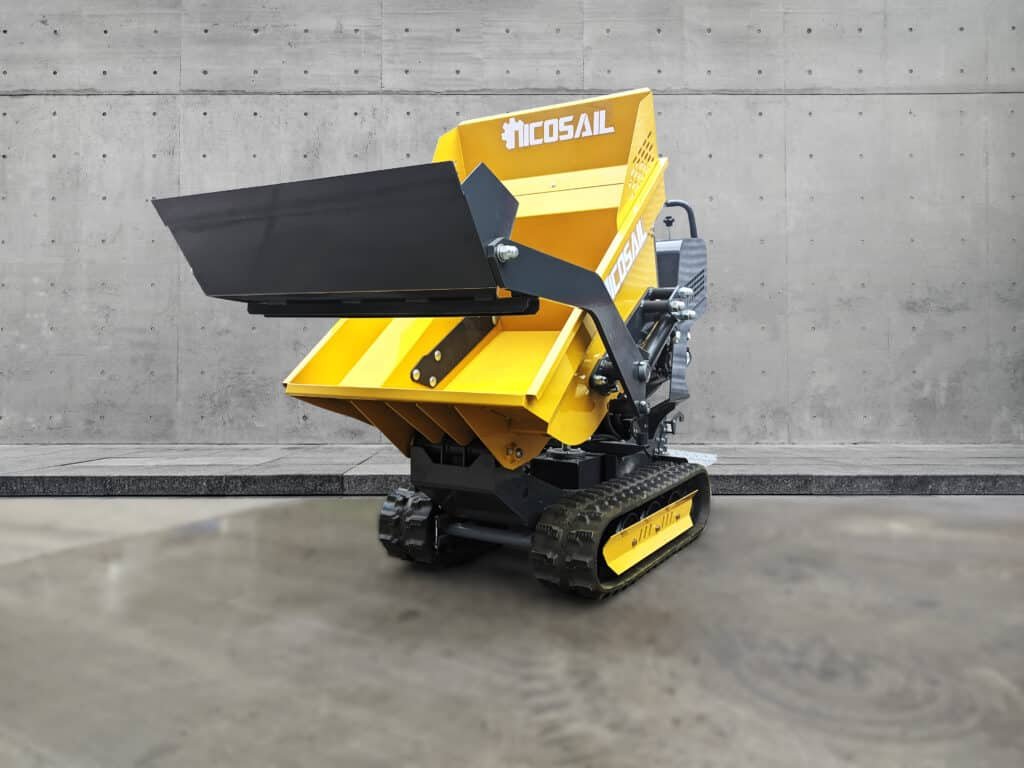
7. Choosing the Right Chinese Factory Partner
7.1 Factory vs. Trading Company
Both can be workable, but the roles are different.
- Direct factory:
- Better control over technical changes
- More transparency on production schedule
- Usually better for OEM branding and longer-term cooperation
- Trading company:
- Sometimes offers more product range from several factories
- But may have less direct control over quality and lead time
One practical approach:
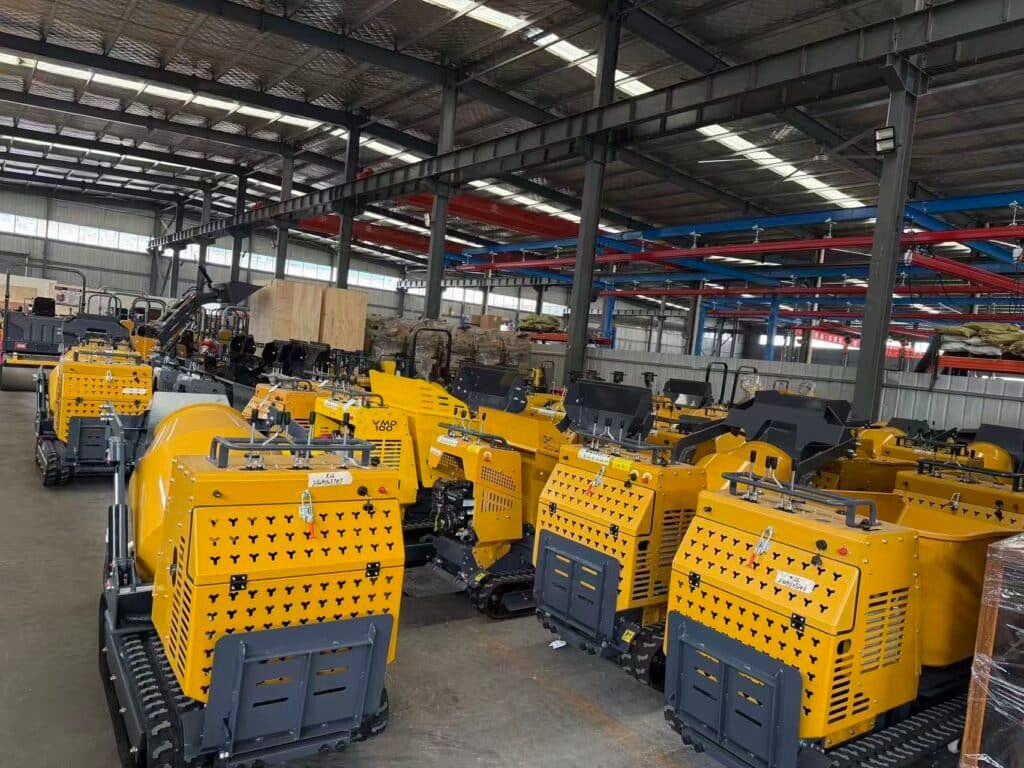
- Work with a real factory that clearly shows workshop, production lines, and testing.
- A brand like Nicosail is positioned as a factory with 5 production lines, which allows better integration of mini dumpers with mini excavators and other compact equipment in one supplier.
7.2 What a Serious Factory Should Be Willing to Share
Good suppliers are usually open to sharing:
- Detailed spec sheet and option list
- Dimensions and weight, including loading capacity per container
- CE or other relevant certificates, at least sample documents
- Engine emission certificates where needed
- Standard test procedures (how each machine is checked before shipment)
- Warranty terms in clear writing
- Spare parts list for the first 1–2 years of operation
If a supplier hesitates to provide basic technical documents, that is a warning sign.
7.3 Pilot Orders, Inspections, and Quality Gates
To control risk:
- Start with a pilot order instead of filling a full fleet immediately
- Arrange a pre-shipment inspection, either:
- In-person by the buyer or a local partner, or
- Through a third-party inspection company
Inspection should include:
- Visual check of welding, painting, hoses, and wiring
- Functional test (driving, tipping, starting and stopping engine)
- Verification of plate data and labels
- Check of serial numbers and engine numbers
Factories that are confident in their work usually welcome inspections, because passing them builds long-term business.
8. Where a Brand Like Nicosail Fits In
Among Chinese manufacturers, companies like Nicosail position themselves as:
- Factories, not just traders, with multiple production lines
- Focused on mini excavators, compact tracked loaders, skid steer loaders, and mini dumpers
- Serving markets in Europe, North America, and Australia
From a buyer’s perspective, this brings some practical benefits:
- Easier to combine machines in one container (mini dumpers + mini excavators)
- Consistent paint color and branding across different machine types
- Unified documentation style and similar control layouts across machines
Since Nicosail is set up for OEM and private-label work, many overseas dealers use such factories to:
- Build a local brand image
- Keep machines visually aligned while customizing features for their own markets
The key point is this: rather than buying random “no-name” machines from different sources, many professional buyers prefer to build a stable partnership with one or two serious factories that can support them for years.
9. When a Chinese Mini Dumper Makes Sense (and When It Doesn’t)
Good Use Cases for a Chinese Mini Dumper
A Chinese mini dumper is often a strong choice when:
- Jobs are short-haul, light-to-medium duty
- Worksites are compact, urban, or residential
- Budget is tight, but having more units available is more important than having a premium brand
- The machine is part of a rental fleet, where customers mainly care if it works and is safe
- A dealer is building a house brand with good value positioning
In these scenarios, a well-chosen Chinese mini dumper can deliver great value and a very attractive TCO.
Situations Where a Premium Brand Might Be Better
There are also situations where a Chinese dumper may not be the best choice:
- High-risk, heavy-duty environments such as mining or continuous 24/7 operation
- Projects where the end customer demands a specific brand
- Cases where long-term resale value is absolutely critical
- Extreme climates or regulations where local support from a big brand is needed on-site
In these cases, the extra cost of a premium dumper may be justified by higher uptime, stronger local support, and resale value.
10. Practical Checklist Before Placing an Order in China
Here is a quick, practical checklist that buyers can literally print and keep:
- Clarify usage
- Payload, daily working hours, type of material, slope, ground conditions.
- Define key specs
- Tracked vs wheeled, payload, engine type, tipping height, dimensions.
- Request detailed documentation
- Spec sheet, manual, CE certificate, engine certificate, wiring diagram or basic hydraulic diagram.
- Ask about components
- Engine brand and model, hydraulic brand, hose brand, bearing suppliers.
- Check factory capability
- Production photos or video, testing process, number of lines, main export markets.
- Request photos or video of real machines under load
- Not only showroom images; look for real dirt and real jobs.
- Clarify warranty and parts support
- Warranty period, what is covered, response time for parts, how parts will be shipped.
- Plan a pilot order and inspection
- Start with smaller quantity, arrange third-party inspection or personal visit.
- Discuss branding and customization
- Colors, logo placement, labels in local language if needed.
- Confirm logistics and lead time
- Incoterms (FOB, CIF, etc.), production lead time, shipping time windows relative to peak season.
Using such a checklist can reduce risk dramatically and turn a “cheap experiment” into a controlled, profitable project.
11. FAQ: Chinese Mini Dumpers, Answered
Q1: How long can a Chinese mini dumper last in real work?
With reasonable quality and normal maintenance, many Chinese mini dumpers can run several thousand hours. For light-to-medium duty use (construction sites, farms, landscaping), a 5–7 year working life is common. Actual life depends heavily on workload, operator behavior, and maintenance routines.
Q2: Are CE and other certificates from China trustworthy?
Certificates can be trustworthy, but they are not all equal. Buyers should always request:
- Clear copies of CE certificates
- Declaration of conformity
- Engine emission certificates if required
Also check that the machine labels, manuals, and plates match the documents. Working with established export factories (such as Nicosail) reduces the risk of incorrect or incomplete documentation.
Q3: What about spare parts if the machine is in Europe or North America?
For critical components like engines and hydraulic parts, many Chinese mini dumpers now use globally available brands. Other parts (bodywork, specific brackets) can be ordered from the factory. Good practice is to:
- Order a starter spare parts package with the first shipment
- Keep stock of common wear parts (filters, belts, hoses, track rollers, etc.)
- Ask the factory for a parts list and exploded diagrams to simplify future orders.
Q4: Is the cheapest Chinese mini dumper always the best deal?
Usually not. Extremely low prices often mean cuts in:
- Steel thickness
- Welding quality
- Component brands
- Testing time
A slightly more expensive but properly engineered dumper often has much better TCO than the absolute cheapest one. The goal is “right value”, not only lowest price.
Q5: Can Chinese mini dumpers meet EU Stage V or EPA Tier 4 emission rules?
Yes, if equipped with the correct engines. Many factories can fit compliant engines from established brands. It is important to confirm:
- Engine model and emission level in writing
- Matching certificates and nameplates
- That the same engine configuration is used on the actual machine being shipped.
Q6: What is a typical order quantity for overseas buyers?
It depends on the buyer type:
- Small dealers or contractors may start from 1–2 units in a mixed container.
- Growing dealers and rental fleets often order full container loads (for example, 6–10 dumpers, or mixed with mini excavators).
Nicosail and similar factories usually support both small pilot orders and bigger runs, especially for long-term partners.
Q7: How long does shipping from China usually take?
Roughly:
- Production time: often 25–40 days, depending on season and quantity
- Sea freight: about 3–6 weeks, depending on destination port
Planning at least 2–3 months ahead of peak season is wise, especially for rental fleets.
Q8: Can Chinese mini dumpers be branded with a local company’s name and color?
Yes. Many factories specialize in OEM / private-label production:
- Custom machine color
- Private logo and model name
- Branded decals and labels
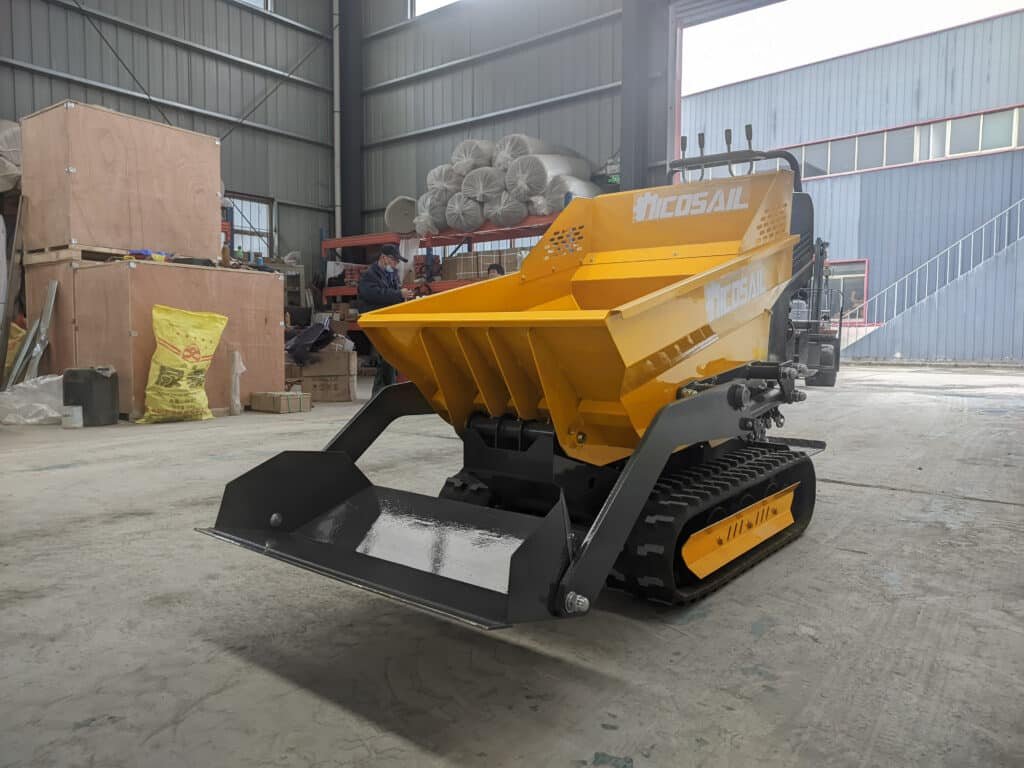
Brands like Nicosail handle this regularly for dealers and distributors in various countries.
12. Final Summary
So, is a Chinese mini dumper worth buying?
The short answer:
Yes, it can be very worthwhile – if the right factory is chosen and TCO is calculated properly.
Key points to remember:
- Chinese mini dumpers offer big savings on purchase price, which can dramatically improve payback time.
- Real-world pros include simple design, easy maintenance, customization options, and strong supply capacity.
- Real risks are quality variance, documentation issues, parts support, and lower resale value.
- When all costs over 5 years are added up, a well-built Chinese dumper can deliver lower TCO than many premium brands, especially for light-to-medium duty work.
- Buyers should focus on factory capability, components used, inspections, and clear documentation, not only on catalog pictures or the lowest quote.
Brands like Nicosail, operating as a real factory with multiple production lines and a focus on export markets, show how Chinese suppliers can move beyond “cheap machines” to become long-term partners for dealers, rental companies, and contractors.
Handled correctly, a Chinese mini dumper is not just a budget option—it can be a profitable, reliable part of a professional fleet.