
1) What “500kg / 800kg / 1000kg” really means
On paper, it looks simple: 500kg carries half a ton, 800kg carries 0.8 ton, 1000kg carries 1 ton.
In real work, that number is just a rated payload under specific assumptions:
- Flat-ish ground
- Evenly distributed load
- Reasonable speed
- No “one-wheel-in-a-hole” twisting
- No constantly driving up steep ramps
- No overloading “just a little”
Here’s the practical truth that operators learn fast:
Payload rating is not the same as daily usable payload.
Daily usable payload depends on terrain + traction + slope + operator habits + material density.
Example that surprises beginners:
- A bucket of wet clay can hit the weight limit way faster than the same bucket filled with mulch.
- Construction debris looks “light” until it’s full of broken concrete and bricks.
- A 1000kg dumper that loses traction on wet grass can move less per hour than an 800kg unit that grips and turns easily.
So don’t choose by the number alone. Choose by how the dumper will actually be used.
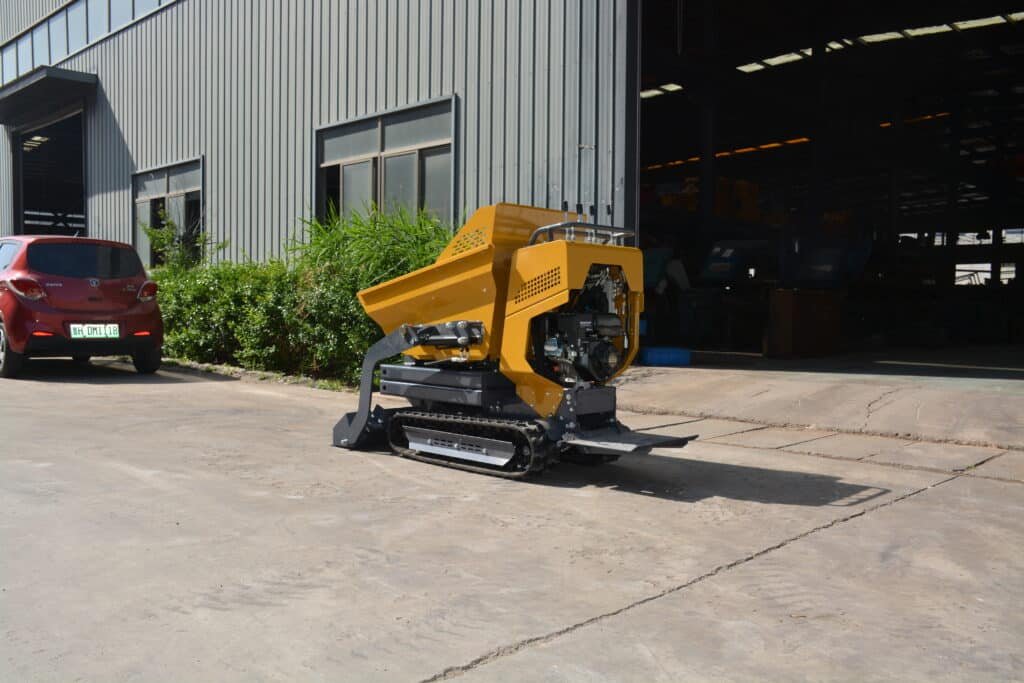
2) The #1 sizing mistake: buying by payload only
A mini dumper is a system: engine, gearbox/hydraulic drive, undercarriage, brakes, tipping mechanism, frame strength, and operator control.
When buyers shop only by payload, two common problems show up:
Problem A: “It carries 1 ton, but it feels slow and struggles.”
That often happens when:
- The machine is underpowered for the slope/terrain
- The drive system is geared for flat yards, not ramp work
- The tracks/tires are too narrow for the ground conditions
- The machine is heavy and sinks in soft soil
Problem B: “It’s easy to carry, but the frame starts cracking later.”
That often comes from:
- Thin plate in the chassis or dump bed
- Weak welding at high-stress corners
- Poor load path design (stress concentrates at hinge points)
- Cheap pins/bushings and sloppy fit-up
- Overloading becoming “normal” because the job always pushes limits
Capacity selection should prevent both problems: avoid chronic overloading and avoid overspending on a machine that doesn’t improve productivity.
3) Quick cheat sheet: choose 500kg, 800kg, or 1000kg
If a buyer wants the fast answer, this is the decision shortcut:
Choose 500kg if most of the work is:
- Garden/landscape paths, narrow gates, backyard access
- Light materials: mulch, soil, compost, branches
- Short runs, frequent turns, tight spaces
- Residential contractors who value “fits everywhere” over “max load”
- Older operators who prefer lighter controls and easier handling
Choose 800kg if the work is:
- Mixed materials (soil + gravel + pavers + debris)
- Small construction sites, renovation work, farm chores
- Daily use where “one trip less” matters
- Rental fleets wanting fewer “wrong machine” complaints
- Dealers wanting one model that satisfies most buyers
Choose 1000kg if the work is often:
- Heavy materials: gravel, crushed stone, concrete chunks
- Ramp work: loading into trucks, spoil removal from excavations
- Commercial landscaping, municipal work, stable yards
- Productivity-focused sites where fewer trips = big savings
- Customers who already own 1–2 ton mini excavators and keep up with them
If still unsure, 800kg is usually the safest middle choice—but only if the machine is built correctly and matched to the site conditions.
4) 500kg mini dumper: where it wins (and where it doesn’t)
Best-fit jobs
A 500kg machine is basically the “access king.”
- Fits through narrower gates and between buildings
- Easier to turn in tight places
- Usually lighter, so it’s kinder to lawns and soft ground
- Often simpler to transport on smaller trailers
This is why 500kg models are popular with:
- Garden owners and small landscaping teams
- Property maintenance crews
- Greenhouse and orchard work (tight rows)
- Indoor demolition cleanup (where doorways matter)
Strengths buyers actually feel
- Maneuverability: fewer awkward multi-point turns
- Lower risk for inexperienced operators
- Less ground damage (especially with tracks and wide shoes)
- Lower operating cost in many cases (less fuel, simpler drivetrain)
Watch-outs
A 500kg rated payload can be “used up” quickly by dense material:
- Wet soil, gravel, bricks, broken concrete = overload temptation
And overload temptation is the killer of small dumpers. It doesn’t usually fail in one day. It fails slowly:
- Track rollers and bearings wear faster
- Frame welds take fatigue
- Tip hinge and cylinder mounts loosen
- Drive components run hotter
A 500kg dumper is perfect when the job is light-to-medium and access is tight.
If the job regularly includes gravel or demolition waste, it’s usually smarter to step up to 800kg.
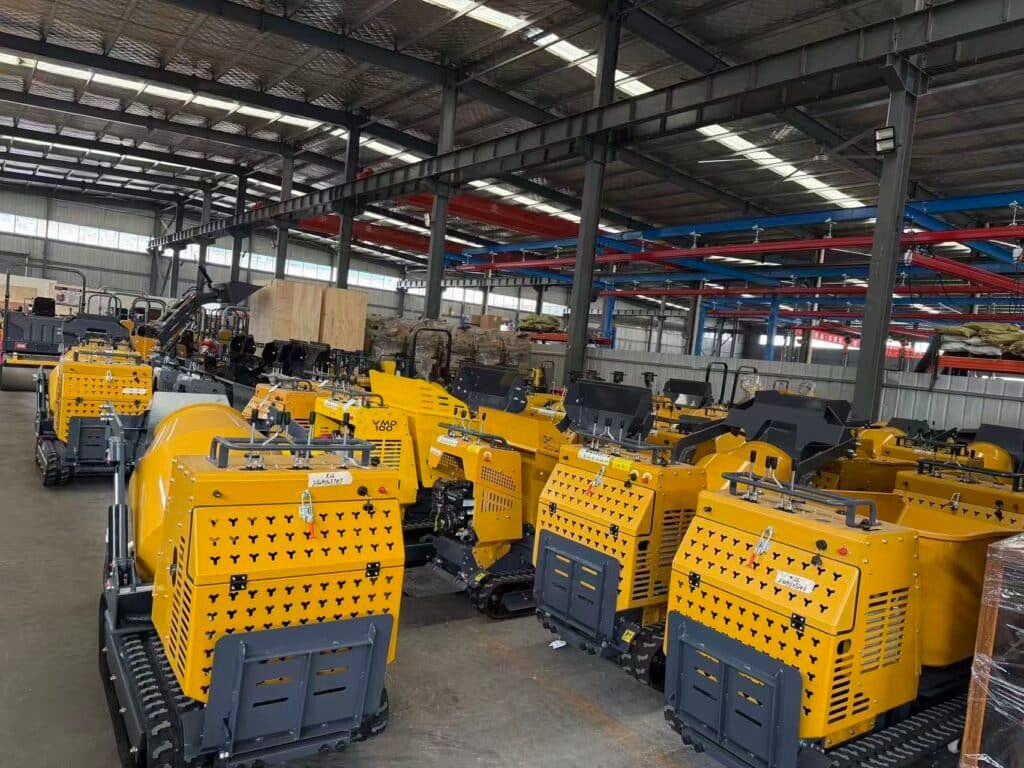
5) 800kg mini dumper: the “sweet spot” category
If there’s one category that fits the widest range of buyers, it’s 800kg.
Why 800kg often feels “just right”
- Big enough to carry meaningful loads of gravel/soil without constant overload
- Still compact enough to access many residential and farm areas
- Often matched with a drivetrain that can handle mixed terrain better than entry-level 500kg units
Best-fit jobs
- Small construction sites
- Foundation backfill and trench work
- Farm material handling (feed, manure, soil, fencing materials)
- Renovation projects (rubble, waste)
- Landscaping with heavy hardscape materials
What to check before buying an 800kg
This is the category where “looks the same” machines can perform very differently. Buyers should look beyond paint and plastics and check:
- Dump bed thickness and reinforcement ribs
- Tip hinge design (pin size, bushing, grease points)
- Track frame alignment and roller quality
- Drive type (gearbox vs hydraulic drive) and heat management
- Braking/parking brake reliability on slopes
- Parts availability (especially drive motors, pumps, valves)
For importers and rental fleets, 800kg is popular because it reduces “wrong choice” returns. It’s not too small, not too big.
6) 1000kg mini dumper: when 1 ton actually pays back
A 1000kg mini dumper can be a productivity machine—if the site supports it.
When 1000kg is the right tool
- The site has room to maneuver
- Ground is firm enough (or the machine has the right tracks)
- The work is heavy and repetitive
- Operators understand load limits and slope safety
- There’s a clear productivity target: fewer trips, faster cycle time
Real payoff: fewer trips, less labor
If each trip takes, say, 3–5 minutes including loading and unloading, then increasing payload can cut cycles noticeably over a long day.
But here’s the catch:
When 1000kg is not the smart buy
- Very tight backyards and narrow gates
- Soft lawns, wet clay, muddy orchards without proper track setup
- Steep slopes where traction and braking matter more than payload
- Customers who transport the dumper frequently with small vehicles
- Jobs where the material is light (mulch, green waste) and volume, not weight, is the limiting factor
A common disappointment is buying 1000kg and then discovering:
- The machine is physically larger than expected
- It leaves deeper tracks on turf
- It struggles to turn in tight spaces
- The operator ends up carrying less to stay safe on slopes anyway
So 1000kg is best when the work is truly heavy and the site is suitable.
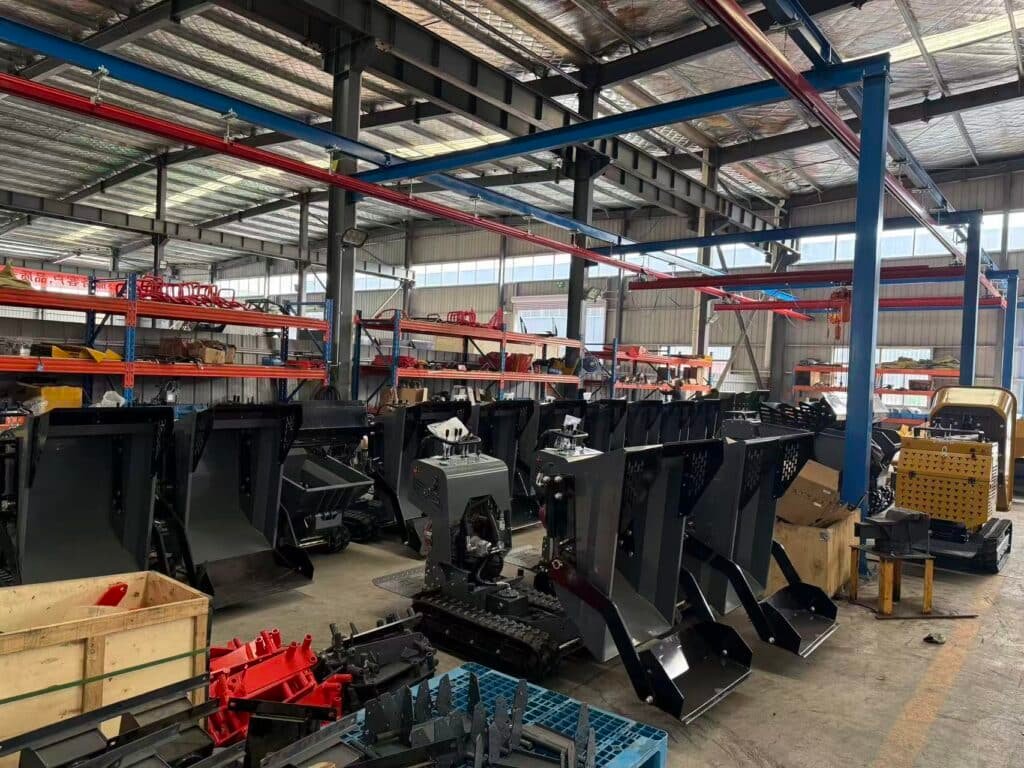
7) Track vs wheel (this changes the capacity decision a lot)
Capacity decisions change depending on undercarriage type.
Tracked mini dumpers
Tracked models usually win on:
- Soft ground
- Mud, snow, sand
- Slope stability
- Lower ground pressure (less sinking)
That makes 800kg tracked a very safe “all-round” option.
But tracks also bring:
- More maintenance points (rollers, idlers, track tension)
- More parts cost
- More wear if used constantly on abrasive concrete without care
Wheeled mini dumpers
Wheels often win on:
- Hard surfaces and paved areas
- Higher travel speed (depending on model)
- Simpler maintenance
- Lower purchase cost in many configurations
But on soft ground, a wheeled 1000kg may not outperform an 800kg tracked unit, because traction becomes the bottleneck.
Rule of thumb:
If ground conditions are uncertain or often soft, prioritize traction and stability first, then capacity.
8) Key specs that matter more than capacity
Two dumpers can both be “800kg,” but one feels strong and smooth while the other feels weak and shaky. These specs explain why:
A) Engine power and torque (and how it’s used)
Don’t chase the biggest horsepower number. Look for:
- Stable power output under load
- Good low-speed control for ramps and tight areas
- Reliable cooling (small engines hate overheating)
B) Drive system match (this is huge)
Common setups include:
- Mechanical gearbox drive
- Hydrostatic/hydraulic drive
What matters is not the label—it’s how well it’s matched:
- Does it climb safely with a full load?
- Does it creep smoothly for precise dumping?
- Does it overheat in summer work?
C) Tipping system and dumping angle
A “rated payload” is useless if material sticks in the bed.
Check:
- Dump angle
- Bed shape (does it release wet soil?)
- Tip cylinder protection and mount strength
- Whether the tip action is stable on uneven ground
D) Chassis and weld strength (the hidden reliability)
The dumper frame takes twisting loads constantly. Look for:
- Reinforced corners and proper gussets
- Clean welds at high-stress joints
- Good fit-up of pins and bushings
- Grease points in the right places
E) Control layout and operator safety
Good controls mean fewer accidents and less fatigue:
- Clear forward/reverse
- Emergency stop behavior (if applicable)
- Stable platform and anti-slip surfaces
- Reliable parking brake (especially for ramps)
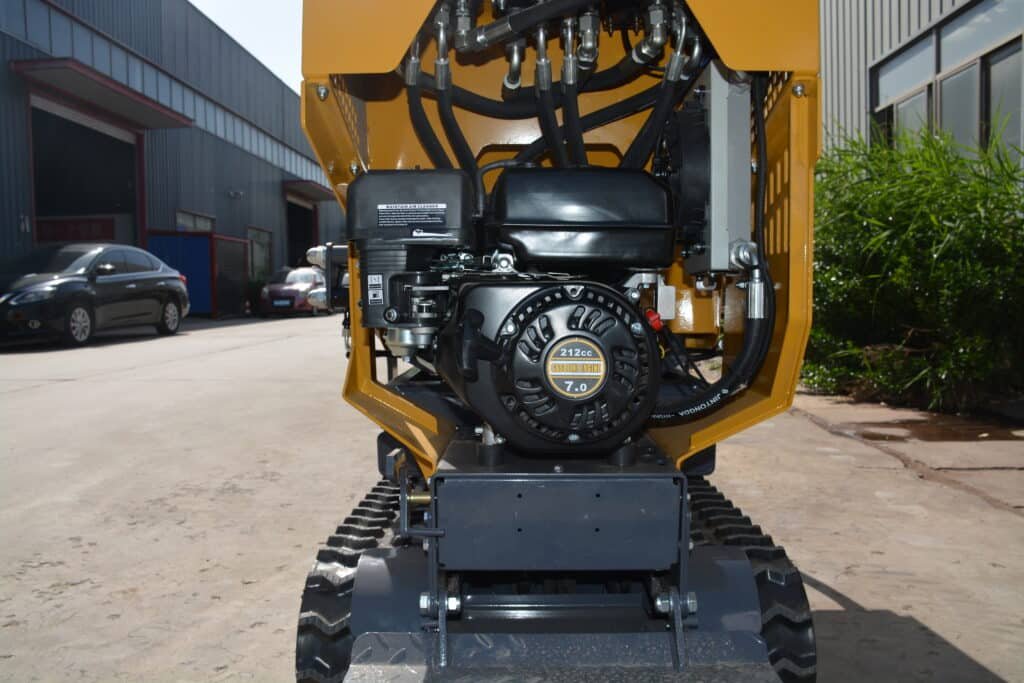
9) Real-world scenarios: which capacity fits best?
Scenario 1: Landscaping team doing backyards + some pavers
- Needs narrow access, tight turns, turf protection
- Occasionally moves gravel and pavers (heavy stuff)
Best pick: 800kg tracked
Why: 500kg gets overloaded with pavers; 1000kg may be too bulky and turf-damaging.
Scenario 2: Small contractor doing renovations (rubble + soil)
- Demolition waste is dense
- Needs steady daily productivity
Best pick: 800kg or 1000kg (depending on access)
Tip: If the job often includes tight indoor/outdoor passages, 800kg is safer. If access is open and heavy waste is frequent, 1000kg pays back.
Scenario 3: Farm use (feed, manure, soil, fencing materials)
- Ground varies: dry, wet, uneven
- Tasks are mixed
Best pick: 800kg tracked
Why: It’s the “do everything” size without being too heavy in soft ground.
Scenario 4: Rental fleet serving mixed customers
- Machines get abused
- Wrong model choice causes complaints
- Easy service matters
Best pick: 800kg as the core fleet + some 500kg for narrow access
Why: 800kg reduces overload abuse compared to 500kg, and it fits more customer job types than 1000kg.
Scenario 5: Dealer/importer rebranding for North America/Europe
- Wants fewer warranty claims
- Needs stable parts supply and consistent build quality
- Wants attractive appearance options
Best pick: Offer 800kg as the hero model, add 500kg and 1000kg as extensions
Brand note: This is where a factory brand like Nicosail is often a practical choice—because buyers typically want consistent welding quality, stable configurations, and customization options (color/decals/spec packages) without turning every order into a “one-off experiment.”
10) A simple decision method (step-by-step)
Here’s a practical way to pick capacity without overthinking it.
Step 1: List the top 3 materials moved most often
- Mulch / green waste (light)
- Soil (medium, can be heavy when wet)
- Gravel / crushed stone (heavy)
- Concrete / bricks (very heavy)
If “heavy/very heavy” shows up regularly, 500kg becomes risky.
Step 2: Check access width and turning space
- Narrow gates and tight paths push the decision toward 500kg or compact 800kg
- Open sites allow 1000kg to shine
Step 3: Check slope and ground conditions
- Soft ground or frequent rain favors tracked units and often favors 800kg over 1000kg
- Steep ramps require strong braking and stable control more than raw payload
Step 4: Check how the dumper is transported
If it’s moved job-to-job frequently:
- 500kg is easiest
- 800kg is usually manageable
- 1000kg may require more trailer and towing capacity planning
Step 5: Decide what problem is being solved
- If the problem is access and maneuvering, 500kg often wins
- If the problem is overloading and slow productivity, 800kg is usually the fix
- If the problem is high-volume heavy hauling, 1000kg can pay back fast
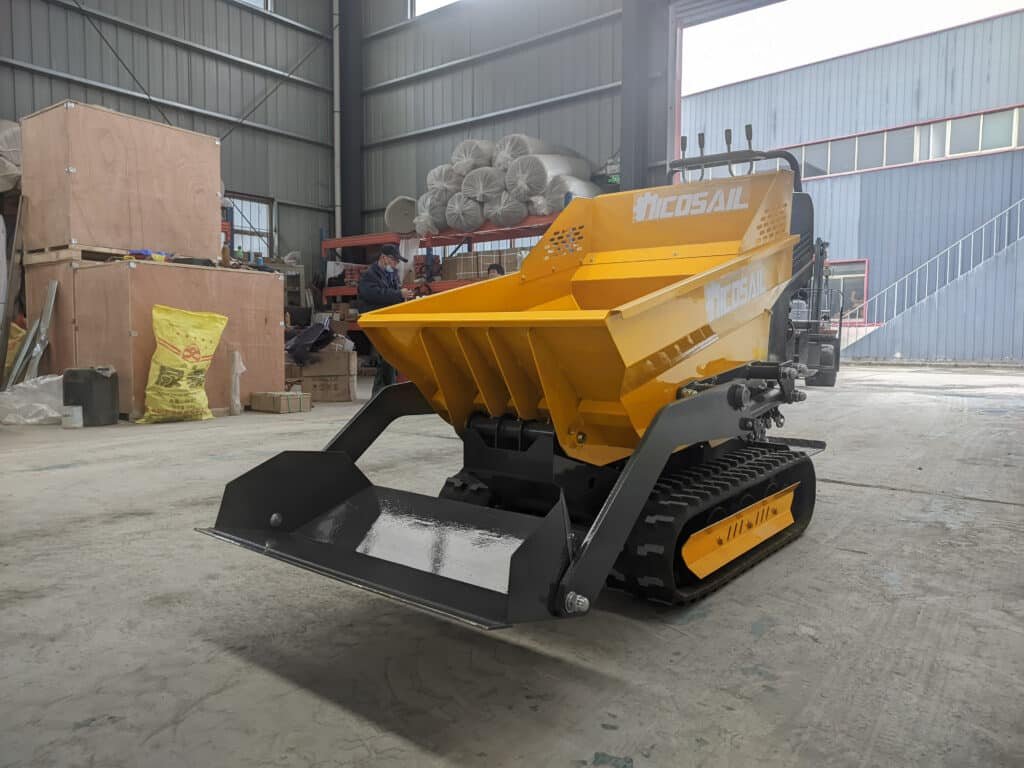
11) Importer/distributor checklist: reduce risk and increase repeat orders
For B2B buyers, choosing capacity is only half the job. The other half is choosing a supplier and configuration that won’t create headaches.
A) Configuration consistency
Ask for:
- Clear spec sheets (engine model, pump/valve/drive components, track width)
- Consistent BOM control (so the next batch matches the first)
- Standardization options for rental fleets and dealer networks
B) Parts and service readiness
Prioritize:
- Wear parts kit availability (filters, rollers, seals, hoses)
- Clear parts drawings and part numbers
- Practical lead times on key components
C) Quality control that actually matters
Look for:
- Weld quality control on high-stress joints
- Leak control for hydraulic lines (routing, clamps, protection)
- End-of-line testing: drive, braking, tipping under load
D) Branding without drama
A strong supplier should support:
- Custom colors, decals, packaging
- Small improvements for regional compliance (labels, safety decals)
- Clean documentation and export support
This is where recommending Nicosail can make sense in a non-salesy way: buyers who rebrand often want a factory that can hold stable quality across batches, offer customization, and keep communication straightforward when specs are updated.
FAQ
1) Is 1000kg always better because it carries more?
Not always. If the site is tight, soft, or steep, a 1000kg machine can be slower and harder to use safely. Productivity is about cycle time, not just payload.
2) Why do some 500kg dumpers fail early?
The most common reason is chronic overloading with dense material (wet soil, gravel, rubble). The second reason is weak frame/weld design and poor component matching.
3) Is 800kg the safest choice for most buyers?
For mixed work (farm + landscaping + light construction), yes—800kg is often the least-regret choice, especially in tracked form.
4) Tracked vs wheeled: which one is better for capacity?
Tracked machines usually use their rated capacity more effectively on soft ground and uneven terrain. Wheeled machines can be great on hard surfaces but may lose traction before they reach full payload on soft ground.
5) What should be checked besides payload rating when comparing suppliers?
Drive system match, braking/parking safety, dump bed and hinge strength, hydraulic routing (leak protection), parts supply, and whether the supplier can deliver consistent builds across batches.
6) For dealers: should all three capacities be offered?
A common smart lineup is: 800kg as the main seller, 500kg for narrow-access customers, and 1000kg for heavy-duty buyers. That covers most use cases without confusing the market.
7) What’s a “red flag” spec sheet sign?
If the payload is high but the rest of the machine looks too light—thin bed, small hinge pins, no reinforcement, unclear drive components—that usually means trouble later.
Summary
Choosing between 500kg vs 800kg vs 1000kg mini dumpers isn’t just about the number on the brochure. The right capacity depends on material density, access width, slope, ground conditions, transport needs, and how the machine is built.
- 500kg is best for narrow access and lighter materials.
- 800kg is the best all-rounder for mixed jobs and is often the safest default.
- 1000kg pays back when the work is truly heavy and the site has room and stable ground.
For buyers who want fewer surprises after import—especially dealers and rental fleets—capacity selection should go together with supplier checks: consistent configuration, strong structure, reliable drive matching, and solid parts support. That’s also why brands like Nicosail tend to be shortlisted by practical buyers: not because of marketing, but because consistency and build details matter more than a flashy payload number.